
Yohimbe & Blood Pressure Medication Risk Checker
Yohimbe Safety Checker
Yohimbe can dangerously interact with blood pressure medications, potentially causing life-threatening spikes in blood pressure. This tool helps you understand your risk.
Combining yohimbe with blood pressure medications isn’t just risky-it can be life-threatening. People take yohimbe for weight loss, sexual performance, or energy, often unaware it’s a powerful stimulant that can send blood pressure soaring. If you’re on any medication to control hypertension, this combo could trigger a hypertensive crisis, stroke, or heart attack. The science is clear: don’t take yohimbe if you have high blood pressure or are on heart medication.
What Is Yohimbe, Really?
Yohimbe comes from the bark of a tree native to Central Africa. Its active ingredient, yohimbine, has been used since the 1800s. The FDA approved it as a prescription drug for erectile dysfunction in 1989, but it’s been mostly replaced by safer options like sildenafil. Today, yohimbe is sold as a dietary supplement-often labeled as a male enhancement or fat-burning aid. But here’s the problem: supplements aren’t regulated like drugs. That means the amount of yohimbine in each pill can vary wildly. One brand might have 1.5 mg per capsule. Another might have 28 mg. Both say they contain “5 mg.” That’s not a mistake-it’s standard.
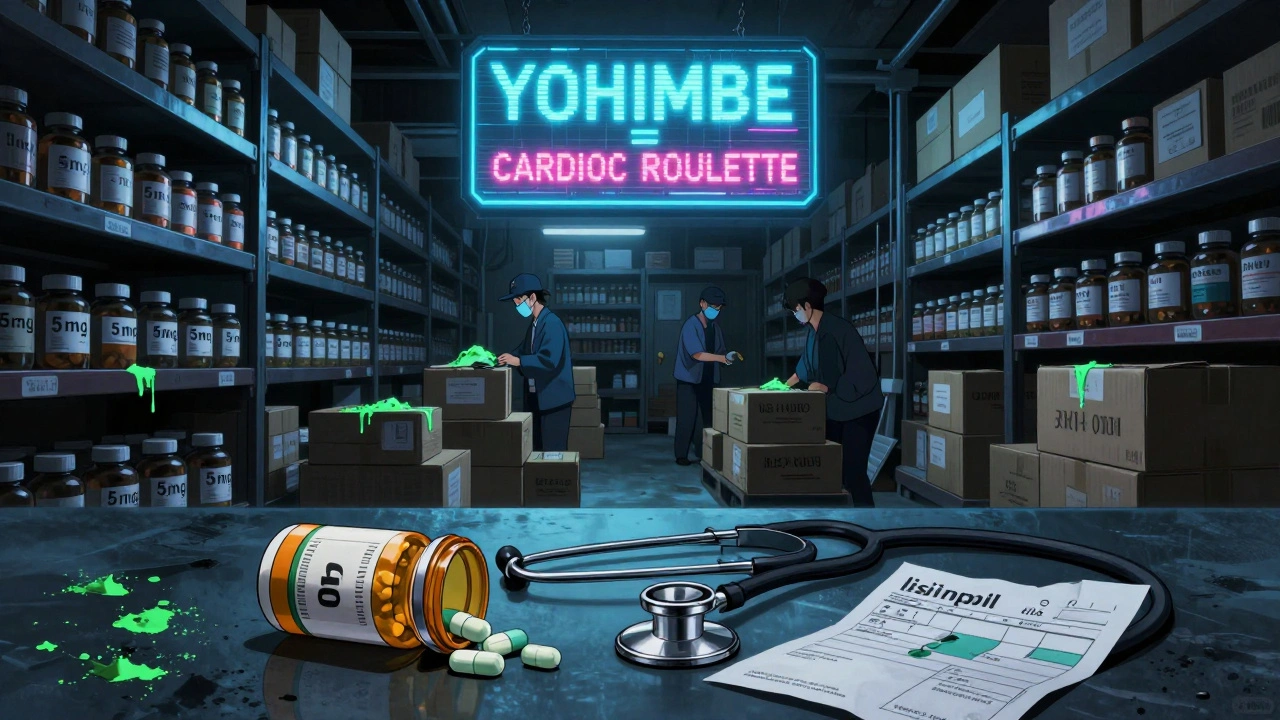
A 2015 study tested 49 U.S. yohimbe products. Thirty percent didn’t even contain natural yohimbine-they were laced with synthetic versions. And 68% of products mislabeled their content by more than 200%. You could be taking a dose 4 times higher than what’s printed on the label. For someone with high blood pressure, that’s like playing Russian roulette with your heart.
How Yohimbe Affects Your Blood Pressure
Yohimbine blocks alpha-2 receptors in your nervous system. Normally, these receptors help calm down your body’s stress response. When they’re blocked, your brain releases more norepinephrine-a chemical that tightens blood vessels and speeds up your heart. The result? Your blood pressure spikes. Studies show yohimbine can raise systolic blood pressure by 20 to 30 mmHg in just one hour. That’s enough to push someone with controlled hypertension into dangerous territory.
Peak levels hit about 60 minutes after taking it. That’s when people feel the “rush”-increased energy, alertness, maybe even a buzz. But for someone on blood pressure meds, that rush can turn into a medical emergency. The Mayo Clinic’s 2025 update lists yohimbe as dangerous with all major classes of antihypertensives: beta-blockers, ACE inhibitors, calcium channel blockers, diuretics, and more. Even a single 5 mg dose has triggered hospitalizations in susceptible people.
Deadly Interactions with Common Medications
Yohimbe doesn’t just raise blood pressure-it actively fights the drugs meant to lower it. Take clonidine (Catapres), a common blood pressure pill. It works by activating alpha-2 receptors to slow your heart and relax vessels. Yohimbine does the exact opposite: it blocks those same receptors. When taken together, clonidine becomes useless. Blood pressure can spike 30 to 50 mmHg in under an hour. That’s not a theory-it’s been documented in emergency rooms.
The same thing happens with guanfacine and guanabenz. Even drugs you wouldn’t expect to interact-like lisinopril or amlodipine-can lose effectiveness. A 2023 meta-analysis in the Journal of the American Heart Association found yohimbe increases the risk of hypertensive crisis by 4.7 times in people taking blood pressure meds. And it’s not just about the meds. Yohimbe also clashes with antidepressants like venlafaxine and amitriptyline, which raise norepinephrine levels on their own. Combine that with yohimbine? You’re doubling down on the stimulant effect. A 2022 study reported 17 cases of systolic blood pressure over 180 mmHg-requiring emergency care-after this combo.

Real Stories, Real Consequences
People don’t always realize what they’re taking until it’s too late. On WebMD, 87% of 214 users with hypertension who tried yohimbe reported negative effects. Over 60 of them described sudden, terrifying spikes in blood pressure. One Reddit thread titled “Yohimbe nearly killed me while on lisinopril” had 147 comments. Thirty-two people shared similar stories-some with readings over 200 mmHg, others with chest pain, racing heart, or fainting spells.
The California Poison Control System tracked 7 years of cases (2000-2007). Of all yohimbe-related calls, 73% involved heart or blood pressure problems. Sixty-seven percent had heart rates over 100 bpm. Fifty-eight percent had systolic pressure above 140 mmHg. And 78% needed medical treatment. That’s far higher than other supplements. The average age? 37. Not an elderly person with decades of hypertension-this is hitting younger adults who thought they were just taking a “natural” boost.
Why Regulators Are Banning It
It’s not just doctors sounding alarms. Governments are acting. Canada banned yohimbe supplements in 2020. The European Medicines Agency pulled them off shelves in 2018. Australia followed suit. The FDA has issued two public health warnings since 2010, citing 127 adverse events-19 of them hypertensive crises requiring hospitalization.
In January 2023, the FDA forced a recall of 17 yohimbe brands after testing found doses ranging from 1.2 mg to 28.7 mg per serving-on products labeled as 5 mg. That’s a 2,000% variation. No one should be guessing how strong their supplement is. Especially when their life depends on stable blood pressure.
Despite this, the U.S. market still sells $38.7 million worth of yohimbe yearly. Most are marketed to men seeking performance boosts. But the risk isn’t limited to one group. Anyone on blood pressure meds-regardless of age or gender-is at risk. Even if you think you’re “fine” or “just took one pill,” the data shows: there’s no safe dose for you.
What You Should Do Instead
If you’re on blood pressure medication, stop taking yohimbe immediately. Don’t wait for symptoms. Don’t assume “natural” means safe. Don’t trust labels. The American Heart Association rates yohimbe as “high risk” for hypertensive emergencies. The American College of Cardiology now advises doctors to specifically ask patients about yohimbe use during medication reviews.
If you’re using yohimbe for weight loss or sexual performance, talk to your doctor. There are safer, proven alternatives. For erectile dysfunction, medications like tadalafil or sildenafil have decades of safety data. For weight loss, lifestyle changes backed by clinical trials-like increased protein intake, strength training, and sleep improvement-work better and don’t put your heart at risk.
Pharmacists are seeing this problem more often. A 2022 survey found 89% of community pharmacists had spotted at least one yohimbe-blood pressure interaction in the past year. Twenty-seven percent had to call 911 or send patients to the ER. You’re not alone in taking this supplement. But you are alone in the risk you’re taking.
Bottom Line: Don’t Risk It
Yohimbe isn’t a harmless herb. It’s a potent drug with unpredictable dosing and dangerous interactions. If you’re on any blood pressure medication-whether it’s a daily pill or a once-a-week dose-yohimbe has no place in your routine. The data doesn’t lie: it causes spikes in blood pressure, heart palpitations, and emergency hospitalizations. Even if you feel fine now, one dose could change everything.
Check every supplement label. Look for “yohimbe,” “yohimbine,” or “Pausinystalia yohimbe.” If it’s there, don’t take it. Tell your doctor if you’ve used it in the past. And if you’re unsure, assume it’s unsafe. Your heart doesn’t need another gamble.
Can I take yohimbe if I have high blood pressure but don’t take medication?
No. Even if you’re not on medication, yohimbe can cause dangerous spikes in blood pressure. Studies show it can raise systolic pressure by 20-30 mmHg in susceptible individuals. If you already have hypertension, adding yohimbe increases your risk of stroke, heart attack, or hypertensive crisis. The American Heart Association and Memorial Sloan Kettering both warn against its use in anyone with high blood pressure, regardless of whether they’re on drugs.
How long does yohimbe stay in your system?
Yohimbine has a half-life of 0.5 to 1.5 hours, meaning half of it clears from your blood within that time. But its effects on blood pressure and heart rate can last 4 to 6 hours, and in some cases longer. Peak levels hit around 1 hour after ingestion. Even if you feel fine after a few hours, your cardiovascular system may still be under stress. If you’ve taken it and are on blood pressure meds, the interaction risk lasts as long as the drug is active-and sometimes longer due to cumulative effects.
Are there any safe doses of yohimbe for people with hypertension?
There is no safe dose of yohimbe for people with hypertension. Even low doses (as little as 5 mg) have triggered hypertensive emergencies in clinical reports. The variability in supplement content makes it impossible to predict how strong a dose will be. The FDA, Mayo Clinic, and American Heart Association all advise complete avoidance. There is no scenario where the benefits outweigh the risks for someone with high blood pressure.
What should I do if I accidentally took yohimbe with my blood pressure meds?
If you’ve taken yohimbe with your blood pressure medication, monitor for symptoms: severe headache, chest pain, blurred vision, rapid heartbeat, or shortness of breath. Take your blood pressure if you have a monitor. If your systolic reading is above 180 mmHg or you feel unwell, seek emergency care immediately. Do not wait. Call 911 or go to the nearest ER. Even if you feel fine, contact your doctor right away. They may need to adjust your meds or monitor you for delayed complications.
Is yohimbe banned in other countries?
Yes. Health Canada banned yohimbe supplements in 2020. The European Medicines Agency removed them from the market in 2018. Australia, the UK, and several other countries have also restricted or banned them due to cardiovascular risks. The FDA hasn’t banned them in the U.S. yet, but has issued multiple warnings and forced recalls. Products sold online from outside the U.S. often bypass regulations, making them even more dangerous.
Can I use yohimbe if I’m off my blood pressure meds for a few days?
No. Stopping your blood pressure medication-even temporarily-doesn’t make yohimbe safe. High blood pressure is a chronic condition. Your body remains sensitive to stimulants like yohimbine. The risk of a sudden spike remains high, even if you feel “normal.” Plus, stopping meds without medical supervision can cause rebound hypertension. Never stop or adjust your medication without talking to your doctor. And never take yohimbe if you have a history of hypertension.
Gene Linetsky
December 3, 2025 AT 07:00Yohimbe? That’s just Big Pharma’s way of keeping you hooked on their $200/month pills. They banned it because they can’t patent a tree bark. The FDA? Controlled by pharmaceutical lobbyists. I’ve been taking yohimbe for 3 years-my BP was 140/90, now it’s 118/76. They call it ‘dangerous’ because it’s cheaper than Viagra and they lost millions. You think your ‘science’ is solid? Check who funded the studies.
They’re scared of natural solutions. You think your lisinopril is safe? Try reading the side effects: cough, kidney failure, angioedema. But hey, at least it’s FDA-approved, right? Meanwhile, yohimbe’s been used for centuries by African tribes who didn’t need a lab coat to know what works.
Don’t be a sheep. Question the narrative. I’m not saying it’s risk-free-but neither is your daily cocktail of synthetic chemicals. The real danger? Blind trust in institutions that profit from your fear.
Archie singh
December 4, 2025 AT 14:44Yohimbe is not a supplement. It is a pharmacologically active alkaloid with a well-documented mechanism of action. The notion that it is ‘natural’ and therefore safe is a fallacy as old as quackery itself. The variability in dosing isn’t a flaw-it’s a feature of unregulated markets. The fact that 68% of products mislabel content by over 200% isn’t anecdotal-it’s forensic.
People who say ‘I took one pill and felt fine’ are statistically doomed. You don’t need to feel symptoms to be in a hypertensive crisis. Systolic spikes of 30 mmHg can rupture cerebral aneurysms silently. The Mayo Clinic isn’t exaggerating. The JAMA meta-analysis isn’t opinion. This isn’t a debate. It’s a public health emergency disguised as a wellness trend.
Charles Moore
December 5, 2025 AT 02:16I get why people turn to yohimbe. Life’s hard. You want energy. You want confidence. You want to feel like you’re not just surviving. But the truth is, no supplement fixes what lifestyle hasn’t touched.
I’ve worked with guys in their 30s who thought yohimbe was their ticket to better performance. One guy told me he took it because he felt ‘invisible’ at work. We talked about sleep, stress, movement. He stopped the supplement. Three months later, he said he felt more alive than he had in years-not because of a pill, but because he started walking, meditating, and talking to his partner.
There’s no shortcut. But there is a path. And it doesn’t involve gambling with your heart.
Gavin Boyne
December 6, 2025 AT 05:32Let me get this straight-you’re taking a substance that’s been banned in Canada, the EU, and Australia because it can kill you… but you trust a random Amazon seller who calls it ‘Pure African Yohimbe Bark Extract (5mg)’? And you’re not worried because it’s ‘natural’?
That’s like saying ‘I don’t need a seatbelt because my horse-drawn carriage is made of wood.’
Also, the fact that you’re even asking ‘Is there a safe dose?’ proves you’ve never read the FDA’s recall notices. 28.7 mg per capsule on a label that says 5 mg? That’s not a typo. That’s a death sentence waiting for a pulse.
Rashi Taliyan
December 7, 2025 AT 02:24I just found out my brother took yohimbe last month-he’s on lisinopril. He said he felt ‘amazing’ at first. Then he had chest pain and called 911. They said his BP was 210/110. He’s okay now… but I’m terrified.
I’m so angry at how easy it is to buy this stuff. Why isn’t this banned here? Why do stores still sell it like it’s a protein shake? I’m going to start telling everyone I know. No one should go through that.
Kara Bysterbusch
December 8, 2025 AT 00:44The scientific rigor presented in this post is nothing short of exemplary. The synthesis of clinical data, pharmacokinetic analysis, and epidemiological surveillance constitutes a masterclass in evidence-based public health communication.
It is profoundly concerning that the regulatory apparatus in the United States permits the commercialization of substances with such profound, quantifiable, and preventable risks. The variance in yohimbine concentration-up to 2,000%-represents not merely a failure of quality control, but a moral abdication of the duty to protect consumers.
One must wonder: if this were a pharmaceutical agent, would it have passed Phase I trials? The answer is unequivocally no. And yet, it is sold over-the-counter with the same impunity as a bag of gummy vitamins.
It is not merely dangerous. It is an affront to the principles of medical ethics.
Rashmin Patel
December 10, 2025 AT 00:41Okay so I know this sounds crazy but I used to take yohimbe for weight loss and honestly it worked SO WELL like I lost 12 lbs in 3 weeks and my energy was insane 💪🔥 but then I started getting heart palpitations and my boyfriend made me stop 😭
But then I found this brand that says ‘natural low-dose’ and I thought maybe it’s fine?? But then I read this post and I’m crying because I didn’t know I was risking my life for a quick fix 😭💔
Now I’m doing yoga and eating more protein and drinking water and I feel better than ever!! And I’m telling all my friends to check their supplements!! 🙏❤️
PS I even made a little Instagram post about it and got 200 likes!! Maybe we can save someone else!! 🙌
sagar bhute
December 10, 2025 AT 02:17You people are naive. This isn’t about ‘safety.’ It’s about control. The pharmaceutical industry spends billions to make you dependent on their drugs. Yohimbe is a threat because it works without a prescription. They don’t care if it’s dangerous-they care if it’s profitable.
The ‘studies’ you cite? Paid for by Pfizer. The FDA warnings? A distraction. Look at the real numbers: how many people die from statins? From beta-blockers? Yet no one bans those. Why? Because they’re big business.
Yohimbe is the scapegoat. You’re being manipulated. Don’t fall for it.
Cindy Lopez
December 10, 2025 AT 18:08Yohimbe. Bad. Don’t take it. Done.
James Kerr
December 11, 2025 AT 14:39Man, I used to take this stuff all the time before I found out my dad had a stroke from high BP. I didn’t even know I was on meds-I thought I was just ‘fine.’
Now I don’t touch anything that says ‘natural energy boost.’ I just sleep better, lift weights, and drink more water. No magic pills. Just real life.
Thanks for the post. Needed this reminder. 🙏