Ever wonder why some prescription drugs cost hundreds or even thousands of dollars a month, while others you can pick up for $10? It’s not because one is better than the other. It’s because brand-name drugs with no generic alternatives are locked in by legal, technical, and financial barriers that keep cheaper versions off the market-even after the original patent expires.
Patents Aren’t the Whole Story
Most people think once a drug’s 20-year patent runs out, generics automatically appear. That’s not true. Patents are just the starting point. Pharmaceutical companies use a mix of legal tools to stretch their monopoly far beyond that. The Hatch-Waxman Act of 1984 was meant to speed up generics, but it also gave drugmakers loopholes. They can file for extra exclusivity if they test a drug in kids (six months), or if they make a new formulation (up to five years). AstraZeneca did this with Nexium. The original patent for esomeprazole expired in 2001, but through a string of new patents on delivery methods and salt forms, they kept generics out until 2014. That’s 13 extra years of high prices.Complex Drugs Can’t Be Copied Easily
Not all drugs are made the same. Simple pills with one active ingredient? Easy to copy. But what about a drug made from something like pregnant mare urine? That’s Premarin, a hormone therapy still sold only as a brand-name drug decades after its patent expired. The active ingredients aren’t fully known-they’re a mix of 10+ estrogen compounds that vary between batches. No generic manufacturer can prove they’ve matched it exactly, so the FDA won’t approve a copy. Same goes for biologics. These are drugs made from living cells, not chemicals. Think Humira, Enbrel, or insulin. They’re too complex to replicate exactly. Instead, companies make “biosimilars,” which are similar but not identical. Getting approval for these takes years of extra testing and clinical trials. The first biosimilar for Humira didn’t hit U.S. shelves until 2023-even though the patent expired in 2016. Why? Legal battles, patent thickets, and the fact that biosimilars need 12 years of data exclusivity under the Biologics Price Competition and Innovation Act.Delivery Systems Are Hard to Reverse-Engineer
It’s not just what’s in the drug-it’s how it gets into your body. Take Advair Diskus, an asthma inhaler. The active ingredient, salmeterol and fluticasone, could be copied. But the device that delivers it? That’s proprietary. The micronized powder, the airflow design, the way the dose is metered-all of it affects how much medicine actually reaches your lungs. Generic makers can’t just buy the same machine. They have to reverse-engineer it, test it on hundreds of patients, and prove it works just as well. The FDA requires bioequivalence within 80%-125%, but for inhalers, even a 5% difference can mean more asthma attacks. That’s why generic inhalers are still rare.
Product Hopping and Pay-for-Delay
Some companies don’t wait for patents to expire. They change the drug slightly just before it happens. This is called “product hopping.” Mylan did this with EpiPen. Instead of letting generics take over, they redesigned the auto-injector-changed the color, added a needle shield, tweaked the spring. They called it a “new” product. The FDA still approved it as the same drug, but now the old patent didn’t apply. The new version got another 5-7 years of exclusivity. Patients paid $600 for two pens. Generic versions didn’t arrive until 2020. Then there’s “pay-for-delay.” Big pharma pays generic companies to stay out of the market. Between 1999 and 2012, there were 297 of these deals. One study found they cost consumers $3.5 billion a year. The FTC tried to stop them, but they’re still happening. In 2023, a settlement was reached over a generic version of the antidepressant Viibryd-delayed for two years after patent expiry. The brand paid the generic maker to wait.Why It Matters for Patients
The cost difference isn’t small. A 2022 GoodRx analysis showed brand-name drugs with no generic alternatives cost 437% more than similar drugs that have generics. For someone on Medicare Part D, that means $5,000 a year out-of-pocket for a drug like Gleevec (imatinib) before generics arrived in 2016. After? $850. That’s an 80% drop. But it’s not just about price. Some patients report differences with generics-even when they’re approved. One user on PatientsLikeMe said the generic version of Spiriva HandiHaler felt “different” in their lungs. For drugs with narrow therapeutic windows-like seizure meds (phenytoin), thyroid meds (levothyroxine), or blood thinners (warfarin)-even tiny variations in absorption can cause real problems. That’s why some doctors stick with brand names, even when generics exist.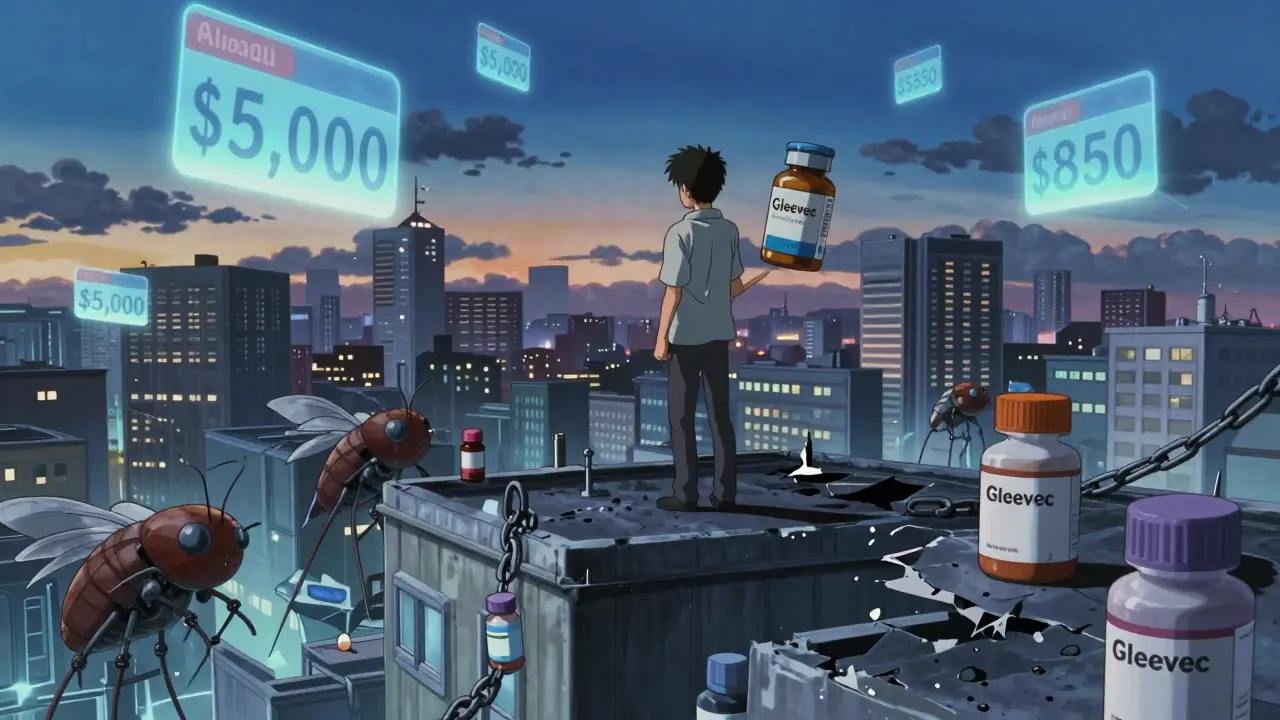
Henriette Barrows
December 31, 2025 AT 00:45Wow, I had no idea so many of these tricks were legal. I’ve been paying $400 a month for my thyroid med and just assumed it was because it’s ‘special.’ Turns out it’s because the company made the pill a different shade of blue and called it a ‘new delivery system.’ 😒
Russell Thomas
December 31, 2025 AT 19:05So let me get this straight - pharma companies pay other companies to NOT make cheaper versions? And this isn’t illegal? I’d rather be robbed at gunpoint than pay for this cartel. 🤡
Alex Ronald
January 2, 2026 AT 01:41Actually, the FDA’s GDUFA III changes are a big deal - they’ve been pushing hard on complex generics like inhalers and injectables. The real bottleneck isn’t always the science, it’s the liability insurance. Generic makers are scared to touch anything with a narrow therapeutic window because one lawsuit can sink them. The system’s broken, but it’s not all corporate greed - it’s also risk-averse bureaucracy.
Duncan Careless
January 3, 2026 AT 03:55Yeah, i read this and thought about my mate in the uk who pays £12 for his insulin via nhs, while his cousin in texas pays $900. same drug. same science. just different rules. its wild. 🤷♂️
Samar Khan
January 4, 2026 AT 04:33Ughhh I hate this so much 💔 my dad died because he skipped doses to make his Gleevec last longer… and now I see it was all just corporate greed? I’m not even mad… I’m just… empty. 😔
Joe Kwon
January 5, 2026 AT 04:42From a regulatory science standpoint, the bioequivalence thresholds for inhalers (80-125%) are fundamentally inadequate for drugs with steep dose-response curves. The FDA’s current paradigm assumes linear pharmacokinetics, but for biologics and complex delivery systems, that’s a false assumption. We need PK/PD modeling-based approval pathways, not just AUC and Cmax comparisons. GDUFA III is a step, but it’s still 1980s thinking applied to 2020s tech.
Jim Rice
January 6, 2026 AT 14:15You’re all being naive. The real problem is patients who won’t take generics because they’re ‘scared’ or ‘feel different.’ That’s not the system’s fault - it’s your ignorance. If you can’t tell the difference between a $10 pill and a $500 pill, maybe you shouldn’t be on meds at all.
Nicole K.
January 7, 2026 AT 15:54So you’re saying it’s okay for companies to lie and cheat just to make more money? That’s not capitalism, that’s evil. And you, Jim, are part of the problem. 🤬