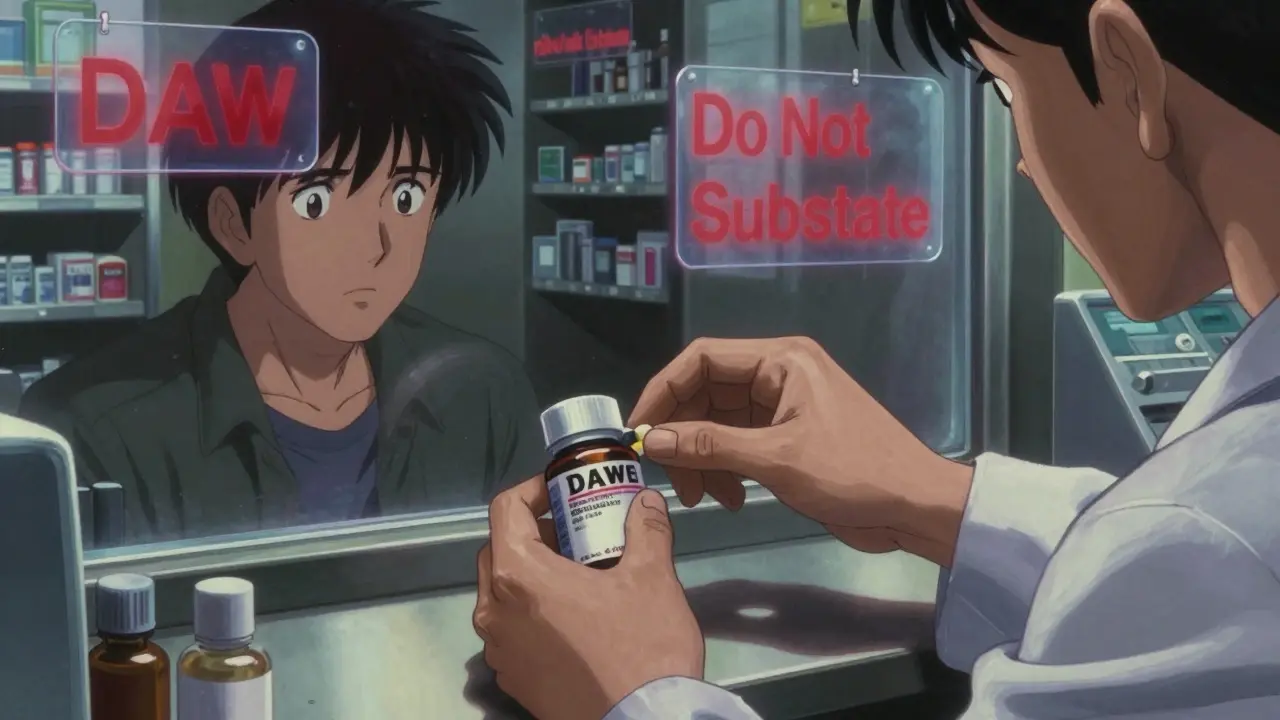
Ever picked up a prescription and been shocked by the price - only to find out your doctor wrote "Do Not Substitute" on it? You’re not alone. Many patients assume generics are just cheaper versions of the same drug. But sometimes, that’s not safe - or even legal - to swap. This isn’t about brand loyalty. It’s about biology, precision, and real patient outcomes.
What Does "Do Not Substitute" Actually Mean?
When a doctor writes "Do Not Substitute" - or "DAW," "Dispense as Written," or "Medically Necessary" - they’re telling the pharmacist: give this exact brand-name drug. No generics allowed. It’s not a suggestion. It’s a legal order under state pharmacy laws. In 49 U.S. states, pharmacists can legally switch a brand drug for a generic unless the prescriber blocks it. That’s thanks to the Hatch-Waxman Act of 1984, which made generics faster and cheaper to approve. But that law also gave doctors a way to override substitution when it matters. The FDA’s Orange Book lists which drugs are considered therapeutically equivalent. But not all drugs fit neatly into that box.Why Some Drugs Can’t Be Swapped
Not all medications are created equal, even if they have the same active ingredient. The biggest red flags come from drugs with a narrow therapeutic index (NTID). These are drugs where a tiny change in blood level can mean the difference between healing and harm. Examples include:- Warfarin (blood thinner)
- Levothyroxine (thyroid hormone)
- Phenytoin (seizure control)
- Cyclosporine (organ transplant)
Biological Drugs Are a Different Story
Biologics - like insulin, rheumatoid arthritis drugs, or cancer treatments - aren’t made from chemicals. They’re made from living cells. That means no two batches are exactly alike. Even small changes in manufacturing can affect how the body responds. That’s why the FDA created a special category called "interchangeable" biosimilars. As of October 2023, only 12 biologics had this designation. Over 10,000 small-molecule generics exist. But for biologics, substitution without explicit approval is risky. In 32 states, pharmacists can’t swap a biologic unless the FDA says it’s interchangeable. So if your doctor writes "Do Not Substitute" on your Humira or Enbrel prescription, they’re not being stubborn. They’re following science.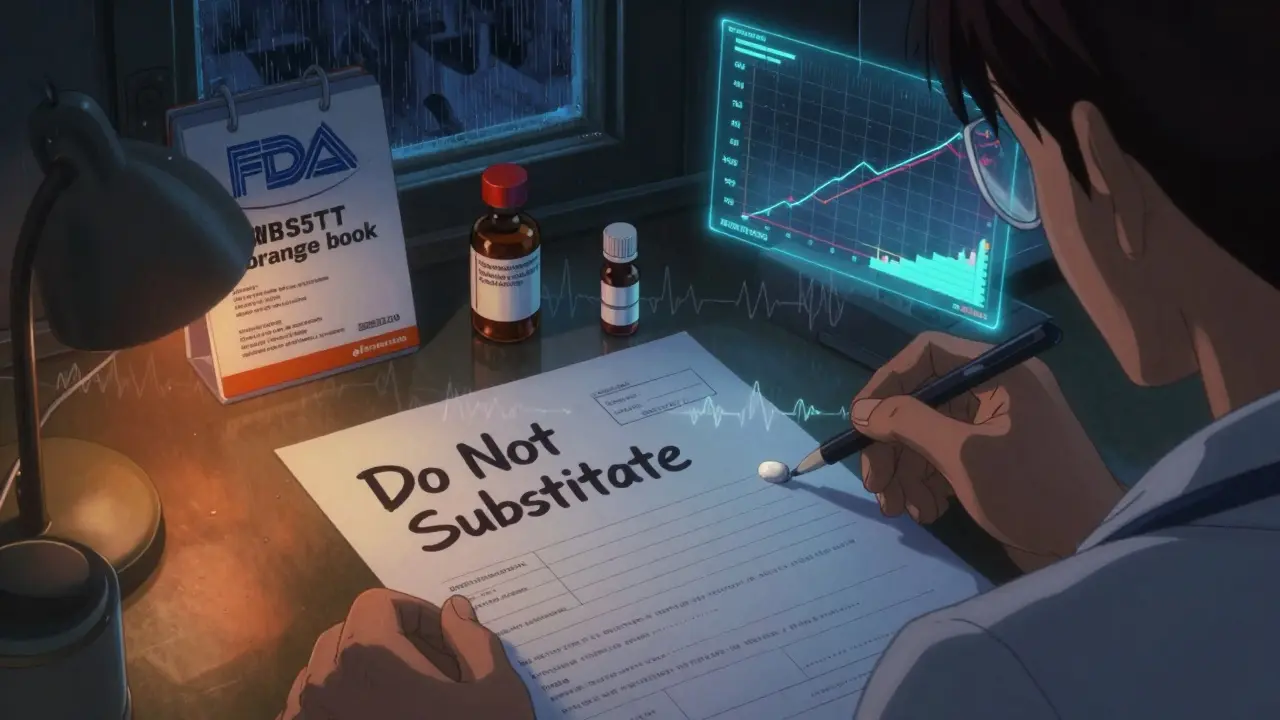
Why So Many Patients Are Surprised
Most people don’t know the difference between brand and generic until they see the bill. A 2022 Kaiser Family Foundation survey found 68% of patients didn’t realize their prescription was brand-only until they paid at the pharmacy. One Reddit user wrote: "My doctor wrote DAW on my Synthroid. Insurance charged me $85 instead of $10. I had to call three people just to understand why." The cost gap is huge. Brand-name drugs with DNS directives cost an average of $487 per prescription. Generics? Around $144. That’s a 237% increase. For patients on Medicare, DNS prescriptions are 12.7% of all scripts - compared to 8.3% for commercial insurance. That’s billions in extra spending every year.When Is "Do Not Substitute" Misused?
Here’s the uncomfortable truth: not every DNS prescription is medically necessary. A 2022 study in Annals of Internal Medicine found that inappropriate DNS use contributes to $15.7 billion in avoidable healthcare costs annually. Some doctors use it out of habit. Others are influenced by pharmaceutical reps. In some specialties, DNS rates are as high as 30% - even for drugs where generics are proven safe and effective. Dr. Aaron Kesselheim from Harvard says: "We’re seeing 25-30% DNS rates in classes where equivalence is well-established. That’s not clinical judgment - that’s brand promotion." The FDA reviewed over 1.5 million bioequivalence studies between 2010 and 2022 and found 99.5% of generics performed identically to brands. So when is DNS truly needed? Three main reasons:- Narrow therapeutic index drugs - 38% of DNS cases
- Patient had a bad reaction to a generic - 29%
- Complex delivery systems - like inhalers, patches, or prefilled pens - 22%

How Prescribers Get It Right
Writing "Do Not Substitute" isn’t just typing a phrase. It’s a legal act. Rules vary by state. In New York, you must write "Dispense as Written" and sign your initials. In California, you can use an electronic checkbox - but you still need to log in with your credentials. Twenty-seven states require electronic prescriptions to include a DAW code (like 0-9) that tells the pharmacy system exactly why substitution is blocked. Electronic health record systems often default to allowing substitution. Doctors have to manually override it. One study found that 32% of DNS orders require a manual fix in Epic systems. And it takes about 2.3 minutes per prescription to document the reason properly. That’s 115 extra minutes for a doctor seeing 50 patients a day. The American Medical Association offers a free CME course on appropriate DNS use. Over 45,000 doctors took it in 2023. It’s not about being difficult. It’s about being precise.What Patients Should Do
If you get a DNS prescription:- Ask: "Why?" - Not in a confrontational way. Just say, "Can you help me understand why this needs to be brand?"
- Ask: "Is there a generic that’s been proven safe for me?"
- Ask: "Will my insurance cover this?" - Many insurers require prior authorization for brand-only prescriptions.
- Check your pharmacy receipt. If you see "substituted" or "generic dispensed," call the pharmacy. It might be an error.
The Future of Generic Substitution
The system isn’t perfect. But it’s evolving. The FDA is investing $50 million over the next five years to improve bioequivalence testing for NTID drugs. That could reduce the need for DNS in the future. Meanwhile, 18 states passed laws in 2023 to limit DNS use to only clinically justified cases. Seven states now require prior authorization before insurers pay for brand-only prescriptions. Analysts predict DNS rates for small-molecule drugs will drop to 5-7% by 2027 as more evidence proves generics are safe. But for biologics? Those rates will likely stay above 50%. The science just isn’t there yet. This isn’t about big pharma vs. generics. It’s about matching the right tool to the right patient. Sometimes, the brand name is the only safe option. Other times, the generic is just as good - and far more affordable. The key is knowing which is which - and making sure your doctor does too.Can a pharmacist refuse to fill a "Do Not Substitute" prescription?
No, pharmacists are legally required to follow a "Do Not Substitute" directive. If a doctor writes DAW or "dispense as written," the pharmacist must give the brand-name drug, even if it costs more. Refusing to do so could result in disciplinary action from the state pharmacy board.
Why does my insurance deny coverage for a brand-name drug with a DNS?
Many insurers require prior authorization for brand-only prescriptions. Even with a DNS, they may ask your doctor to prove the generic won’t work for you - especially if it’s a drug with well-established therapeutic equivalence. If the documentation isn’t clear, the claim gets rejected. Your doctor may need to submit a letter or fill out a form explaining the medical necessity.
Can I ask my doctor to switch from a brand to a generic if I’m paying out of pocket?
Yes, you can. If you’re paying the full price and the brand is significantly more expensive, ask your doctor: "Is there a generic version that’s safe for me?" Many doctors will reconsider if cost is a barrier - especially if your condition isn’t high-risk, like a chronic condition with stable control and no history of adverse reactions to generics.
Are all generics the same, or do some brands make better ones?
All approved generics must meet the same FDA standards for strength, purity, and bioequivalence. But different manufacturers use different fillers, coatings, or manufacturing processes. For most people, this doesn’t matter. But for patients with rare allergies to certain dyes or fillers - or those on narrow therapeutic index drugs - one generic might work better than another. That’s why some doctors specify the brand: they’ve seen which version works best for a particular patient.
Does "Do Not Substitute" mean the drug is better?
No. It doesn’t mean the brand is stronger, safer, or more effective. It means that for your specific case - due to your condition, history, or the type of drug - switching to a generic could pose a risk. For 99.5% of drugs, generics are just as effective. But for a small group of patients and certain drug types, that small difference matters.
Raja P
December 24, 2025 AT 07:44I got my Synthroid switched to a generic once and felt like a zombie for two weeks. My doctor didn't warn me. Never again. I don't care if it costs more - my thyroid doesn't negotiate.
Austin LeBlanc
December 26, 2025 AT 00:20Wow, another one of these ‘big pharma is evil’ rants. You realize generics are tested against the brand, right? The FDA doesn’t just let anyone slap a label on a pill and call it ‘equivalent.’ If your body freaks out on a generic, maybe you’re just weird. Stop blaming the system.
niharika hardikar
December 26, 2025 AT 18:22It is imperative to underscore that the pharmacokinetic variance in narrow therapeutic index (NTID) agents is not merely a clinical consideration - it is a bioequivalence threshold that, when breached, precipitates iatrogenic morbidity. The FDA’s 90-112% absorption window is a statistical artifact, not a biological guarantee. For levothyroxine, even a 5% deviation can induce subclinical hypothyroidism in susceptible individuals. This is not about cost - it is about physiological fidelity.
Christine Détraz
December 28, 2025 AT 10:06I used to think generics were always fine until my mom had a seizure after switching her phenytoin. The pharmacy didn’t even tell us it was changed. Now I ask every single time - and I thank my doctor for writing DAW. It’s not about trust in big pharma. It’s about trust in your own body’s response. Some people just need the exact same formula. No shame in that.
Aurora Daisy
December 28, 2025 AT 19:25Oh, so now Americans are too delicate to handle generics? In the UK, we’ve been using generics for decades. Our NHS saves millions. Maybe if you stopped treating your body like a fragile porcelain doll, you’d save yourself some cash. Also, why does every US prescription cost more than my rent?
Paula Villete
December 29, 2025 AT 19:45Y’all are overthinking this. I switched my blood pressure med to generic and my BP went from perfect to ‘I think I’m dying.’ My doctor laughed and said, ‘You’re one of those people.’ Turns out I am. So yeah - if you feel weird after a switch? Listen to your body. Not the algorithm. Not the pharmacist. Not your insurance rep. Your body. It’s not magic. It’s biology. And yes, I spelled ‘biological’ right this time.
Georgia Brach
December 30, 2025 AT 08:09Let’s be clear: the 99.5% bioequivalence statistic is misleading. It’s based on population averages. It ignores inter-individual variability. It ignores cumulative exposure. It ignores the fact that 1% of 1.5 million studies still represents 15,000 cases where generics failed - and most of those patients were never followed up. This isn’t science. It’s cost-driven complacency disguised as evidence.
Bhargav Patel
December 30, 2025 AT 18:01There exists a profound philosophical tension between the principle of equitable access to medicine and the imperative of individualized therapeutic precision. While the economic rationale for generic substitution is compelling, it must not supersede the ontological reality of human physiological variance. One may observe that the human body is not a machine calibrated to statistical norms - it is a dynamic, adaptive system, sensitive to micro-variations in excipients, dissolution kinetics, and metabolic pathways. To reduce patient care to a spreadsheet is to misunderstand the essence of healing.
Steven Mayer
December 30, 2025 AT 18:31Let’s not romanticize patient autonomy. Most patients don’t understand pharmacokinetics. They don’t know what NTID means. They just want the cheapest option. And doctors? They’re overworked. Writing DAW is easier than explaining. The real problem isn’t the system - it’s the lack of education. Neither patients nor providers are equipped to make informed decisions. So we default to ‘Do Not Substitute’ - not because it’s perfect, but because it’s the least bad option in a broken system.
Charles Barry
January 1, 2026 AT 07:16Here’s the truth they don’t want you to know: the FDA and big pharma are in bed together. The ‘interchangeable’ biosimilar designation? A scam. The bioequivalence studies? Paid for by the brand manufacturers. The 1,200 adverse events? Buried in obscure databases. And now they want you to believe generics are safe? Wake up. This isn’t medicine - it’s corporate control disguised as science. Your insulin? Your thyroid med? Your seizure drug? They’re all being manipulated. You’re being dosed with untested crap. And they call it ‘affordable.’