
When a prescription drug carries serious risks-like birth defects, life-threatening blood disorders, or severe organ damage-the FDA doesn’t just slap on a warning label and call it done. Instead, it may require a REMS program: a Risk Evaluation and Mitigation Strategy. These aren’t optional. They’re legally mandated, tightly structured systems designed to let patients get life-saving medications while keeping dangerous side effects from spiraling out of control.
What Exactly Is a REMS Program?
A REMS program is a formal plan approved by the U.S. Food and Drug Administration (FDA) to manage known or potential serious risks tied to certain medications. It’s not a suggestion. It’s a requirement built into the drug’s approval or kept in place after approval if new safety issues arise. The legal foundation came from the Food and Drug Administration Amendments Act of 2007 (FDAAA), which gave the FDA clear power to enforce these programs under Section 505-1 of the Federal Food, Drug, and Cosmetic Act.
Before REMS, high-risk drugs like thalidomide (used for leprosy and multiple myeloma) and isotretinoin (for severe acne) had scattered safety rules. Some required pregnancy tests. Others needed special prescriptions. But there was no consistent, nationwide system. REMS changed that. Now, every drug with a REMS has a unified, enforceable plan.
As of late 2024, about 120 REMS programs are active in the U.S., covering roughly 185 different drugs. That’s about 5.7% of all prescription medications on the market. The majority are for cancer treatments, autoimmune disorders, and neurological conditions-drugs where the benefit is huge, but the risk can be deadly.
The Three Core Parts of a REMS Program
Not every REMS is the same. But they all include at least one of three key components, and many combine them.
- Medication Guides: These are printed handouts given to patients with each prescription. They explain the risks in plain language-what to watch for, when to call a doctor, and how to avoid harm. About 78% of current REMS require these.
- Communication Plans: These target healthcare providers. They might include letters from the drugmaker, training modules, safety alerts, or webinars. About 62% of REMS include these. The goal? Make sure doctors, nurses, and pharmacists know exactly how to use the drug safely.
- Elements to Assure Safe Use (ETASU): This is the strictest layer. It’s required in nearly half of all REMS programs. ETASU can include:
- Prescriber certification-doctors must complete training and register before they can write the prescription.
- Pharmacy certification-only specially approved pharmacies can dispense the drug.
- Restricted distribution-some drugs can only be given in hospitals or infusion centers.
- Documentation-before dispensing, the pharmacy must confirm the patient has met all safety conditions (like recent lab results or pregnancy tests).
- Patient enrollment in registries-some patients must be tracked in a national database to monitor long-term effects.
For example, the REMS for lenalidomide (Revlimid®) requires all three layers. Prescribers must be certified. Pharmacies must be accredited. Patients must enroll in a registry, get monthly pregnancy tests, and sign forms acknowledging the risks. It’s not just paperwork-it’s a full system.
How a REMS Gets Created and Maintained
When a drug company applies for FDA approval and the agency sees a serious risk, it can require a REMS before the drug even hits shelves. Or, if problems show up after the drug is already on the market, the FDA can demand a REMS later.
The manufacturer has 120 days to design a full REMS proposal. This includes:
- Clear goals for reducing the specific risk
- Detailed steps for prescribers, pharmacists, and patients
- Materials like forms, training modules, and patient guides
- A timeline for evaluating whether the program works
The FDA reviews the proposal using a benefit-risk framework. Will the drug save lives? Are there alternatives? Can the risk be controlled without making the drug too hard to access? If the answer is yes, the REMS gets approved.
But the work doesn’t stop there. Drugmakers must submit periodic reports to the FDA-usually every year-showing whether the REMS is working. Has the number of adverse events gone down? Are patients still getting the drug? Are providers able to follow the rules? If the FDA finds the REMS isn’t helping, they can remove it. Only three REMS programs have been fully discontinued since 2007.
Who Pays for REMS? And Who Bears the Burden?
Manufacturers pay for the entire REMS program. The FDA estimates it costs about $2.7 million per year per REMS. That’s for designing materials, training staff, running registries, maintaining online portals, and hiring staff to manage compliance.
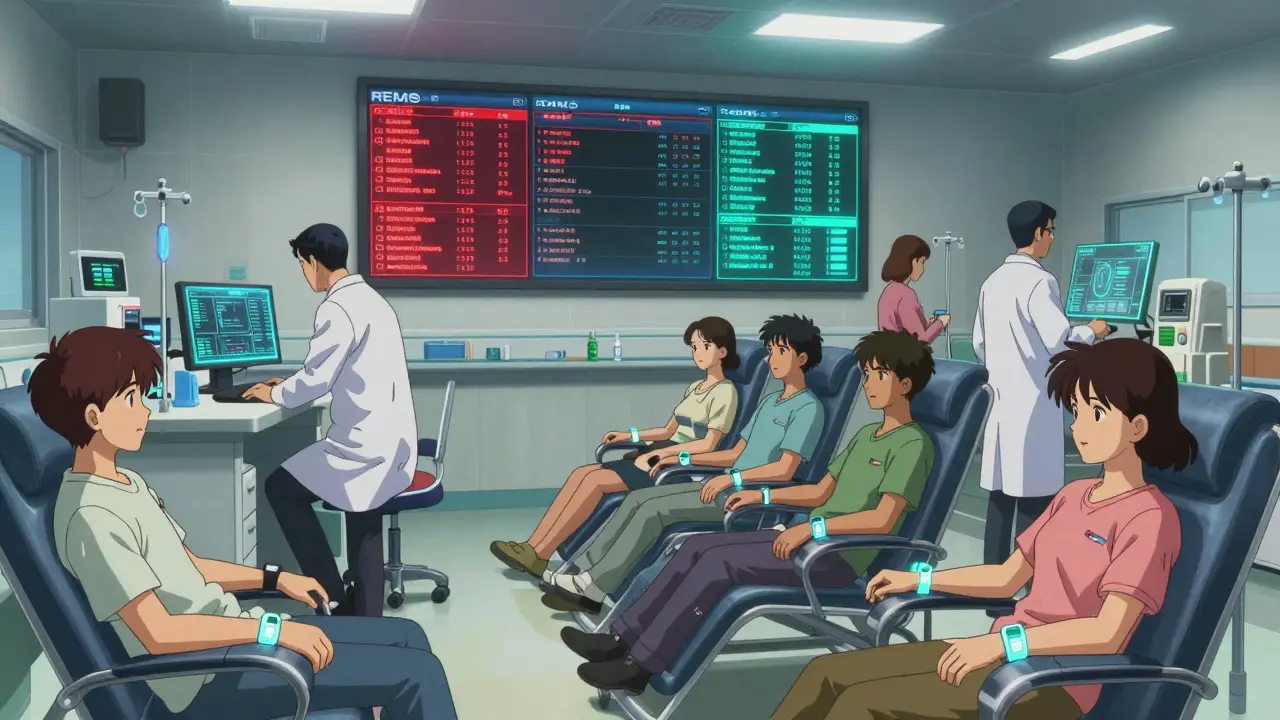
But the cost isn’t just financial-it’s time. Healthcare providers spend hours on REMS tasks:
- Doctors: 45 minutes on average per REMS to get certified.
- Hematologists: 5+ hours per week managing REMS for drugs like Revlimid® and Pomalyst®.
- Pharmacists: Up to 20 minutes per prescription just to check certification status through online portals.
Specialty pharmacies handle 89% of REMS drugs because they’re equipped to manage the complex logistics-tracking inventory, verifying certifications, and documenting every step. But even they struggle. A 2024 survey found only 32% of providers felt the FDA’s REMS support resources were adequate.
Patients pay too-not in money, but in delays. A 2023 GoodRx survey found 42% of patients prescribed REMS drugs experienced at least one treatment delay. One patient waiting for Lemtrada (alemtuzumab) for multiple sclerosis had to wait three weeks because her doctor hadn’t completed certification. Another had to drive two hours to a specialty infusion center because her local pharmacy wasn’t authorized to dispense the drug.
Why REMS Makes Generic Drugs Harder to Launch
One of the biggest criticisms of REMS is how it blocks generic competition. To make a generic version of a REMS drug, the generic company must get samples of the brand-name drug to prove its product works the same way. But if the brand-name company controls the REMS-like the pharmacy network or certification system-they can delay or refuse to provide samples.
A 2024 Health Affairs study found that 78% of generic manufacturers faced delays averaging 14.3 months just to get the samples they needed. That means patients wait longer for cheaper options. In some cases, generic versions never come out at all.
The FDA has started pushing back. The 21st Century Cures Act Reauthorization (2022) now requires the agency to create a standard for evaluating REMS effectiveness by December 2025. One proposed fix? A 90-day review window for generic companies to request samples. If the brand company refuses without good reason, the FDA could step in.
What’s Next for REMS? Modernization Is Coming
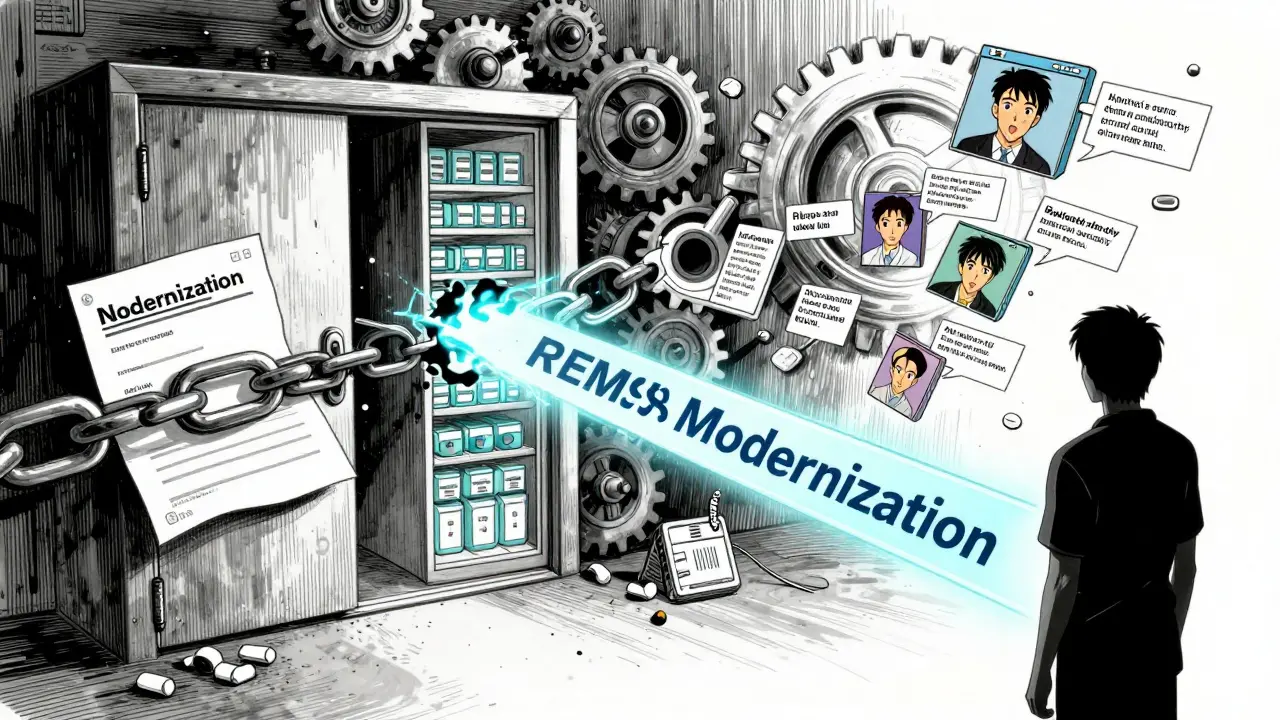
The FDA knows REMS can be clunky. In 2023, they launched the REMS Modernization Initiative. The goal? Keep patients safe without drowning providers in paperwork.
Here’s what’s changing:
- Standardized forms and digital portals instead of 10 different systems for 10 different drugs.
- Integration with electronic health records so certification and lab results auto-populate.
- A public REMS Dashboard by Q3 2025 that shows real-time data on program effectiveness and burden.
- More use of real-world data-like insurance claims and patient-reported outcomes-to measure safety instead of relying on manual reporting.
For example, instead of requiring a patient to call in a pregnancy test result, the system could automatically pull it from the hospital’s lab records. Instead of a paper Medication Guide, patients might get a secure link to a video explanation in their preferred language.
Experts believe these changes will cut administrative time by up to 40% while maintaining-or even improving-safety.
Is REMS Working?
Yes-and it’s saving lives. The FDA estimates REMS programs prevented $8.4 billion in healthcare costs in 2023 by avoiding hospitalizations and complications. For drugs like thalidomide, which caused thousands of birth defects in the 1950s, REMS has made it possible to use the drug safely for cancer patients without repeating history.
But it’s not perfect. The system is fragmented. It’s expensive. It’s slow. And it’s often confusing for patients and providers alike.
The real test isn’t whether REMS exists. It’s whether it’s evolving. The push for digital tools, standardized processes, and faster access to generics shows the FDA is listening. The goal isn’t to remove REMS. It’s to make it smarter.
Are REMS programs only for brand-name drugs?
No. REMS programs apply to both brand-name and generic drugs. If a brand-name drug has a REMS, any generic version must follow the same requirements. This means a generic version can’t hit the market until the REMS system is fully in place and the manufacturer has access to the necessary samples and certification systems. In practice, this often delays generic availability.
Can a REMS program be removed?
Yes, but it’s rare. The FDA can remove a REMS if evidence shows it no longer improves safety or if the drug’s risk profile has changed. Since 2007, only three REMS programs have been fully discontinued. The most recent was for Zeposia (ozanimod), a multiple sclerosis drug, in March 2023, after the FDA determined its safety risks were well-managed through standard labeling and provider training.
Do patients have to pay extra for REMS drugs?
No, patients don’t pay directly for REMS requirements. However, the costs of running REMS programs (certification, specialty pharmacies, monitoring) are often built into the drug’s price. This can make REMS drugs more expensive than similar medications without REMS. Insurance usually covers the drug itself, but patients may face delays or logistical hurdles-like needing to visit a specialty pharmacy-that indirectly affect access.
How do I know if my prescription has a REMS?
Your prescriber or pharmacist should tell you. Medication Guides are given with each prescription for REMS drugs. You’ll also see specific instructions on how to get the drug-like "Must be dispensed by a certified pharmacy" or "Requires prescriber certification." You can also check the FDA’s public REMS database at [email protected], which lists all active programs and their requirements.
Why do some REMS require hospital administration?
Some drugs carry risks so severe that they must be given under direct medical supervision. For example, Lemtrada (alemtuzumab) can cause serious autoimmune reactions days or weeks after infusion. Requiring hospital administration ensures trained staff are present to respond immediately if complications arise. This is part of the Elements to Assure Safe Use (ETASU) and is only used when the risk can’t be managed safely in a clinic or pharmacy.
Agnes Miller
February 17, 2026 AT 03:17Just got prescribed Revlimid last month. The paperwork was insane. Certified doctor, certified pharmacy, monthly pregnancy test, registry enrollment... I swear, it felt like applying for a secret government program. But honestly? I'd rather have this than risk birth defects. Still, 3 weeks to get my first refill? Ridiculous.
Brenda K. Wolfgram Moore
February 17, 2026 AT 14:08The system isn't perfect but it's saving lives. I work in oncology and seen too many patients lose access to life-saving drugs because we cut corners. REMS is annoying but necessary. The FDA’s pushing for digital integration-that’s the real win.
Linda Franchock
February 18, 2026 AT 23:42Oh honey, you think this is bad? Try being a pharmacist trying to verify 12 different certification portals before 8am. I’ve got 17 REMS drugs on my shelf and half the prescribers haven’t updated their certs since 2021. And don’t get me started on the ‘Medication Guide’ that’s 14 pages long and written in font size 6.
Also-why is the FDA making us print these? My patients all have phones. Just send a secure link. We’re not in 2008 anymore.
Jonathan Ruth
February 20, 2026 AT 01:20REMS is corporate welfare disguised as safety. Drug companies charge $10k a pill then whine about costs. They design these systems to make generics impossible. The FDA is a puppet. Let me guess-pharma lobbyists wrote the 21st Century Cures Act too. Wake up people. This isn’t safety. It’s monopoly protection.
Philip Blankenship
February 20, 2026 AT 21:28I’ve been on a REMS drug for MS for 5 years. It’s a pain, no doubt. But here’s the thing-I’ve had zero side effects because the system caught things early. My doctor got flagged because my labs were off, they called me in, we adjusted the dose. That’s what this is for. It’s not about bureaucracy. It’s about not dying. I get why people hate it. But if you’ve ever had a loved one almost die from a drug mistake, you’d see it differently.
And yeah, the paperwork sucks. But imagine if we didn’t have it. Would you really want to be the patient who got lucky? Or the one who didn’t?
Kancharla Pavan
February 20, 2026 AT 22:33This is what happens when you let corporations control healthcare. The FDA is complicit. Patients suffer delays, providers burn out, and the manufacturers profit from forced dependency. Why should a generic drug maker wait 14 months just to get a sample? That’s not safety-that’s theft. The government should force brand manufacturers to release samples immediately or lose their patent. No more games. Lives are not bargaining chips.
And why are we still using paper forms in 2024? My 80-year-old mother has to fax her pregnancy test results. This is medieval. The tech exists. The will doesn’t.
Tony Shuman
February 21, 2026 AT 05:00REMS is a government overreach. If you want to take a drug, take it. If you die, you die. I’m not a child. I don’t need a 12-step program to get my medicine. This is socialism with a white coat. They think we’re dumb. We’re not. Let us decide. The FDA doesn’t know better. They just like control.
Haley DeWitt
February 22, 2026 AT 23:59OMG YES. I just had to wait 3 weeks for Lemtrada because my neurologist hadn’t completed certification 😭😭😭 I almost had to cancel my infusion. Thank you for writing this-this is exactly what’s happening. And yes, I had to drive 90 minutes to a specialty pharmacy. My insurance covered the drug, but not the gas. And yes, I cried. I’m not even mad anymore. Just tired.
John Haberstroh
February 23, 2026 AT 07:53REMS is like a Rube Goldberg machine built by engineers who got their degrees in bureaucracy. You’ve got certification portals that crash, paper forms that vanish, and pharmacists playing telephone with hospital labs just to confirm a patient’s last bloodwork. It’s absurd. But here’s the kicker-it works. I’ve seen patients who’d be dead without it. The problem isn’t the goal. It’s the execution. We need a single digital hub, not 120 different systems. One login. One dashboard. One truth. And maybe-just maybe-stop making patients carry a binder of REMS paperwork like it’s a sacred text.