
Ever opened a prescription bottle and stared at the label like it was written in code? Medication instructions that say "take as needed" or "q.d." or "one tab po q am" can leave you more confused than when you walked into the pharmacy. You’re not alone. In fact, nearly 1 in 4 American adults takes three or more medications, and unclear directions are one of the top reasons people make dangerous mistakes - like taking too much, too little, or at the wrong time.
These aren’t just minor mix-ups. The Institute for Safe Medication Practices reports that unclear drug instructions contribute to over 1.5 million medication-related injuries every year in the U.S. Some of these errors lead to hospital visits. Others lead to permanent harm. The good news? You don’t have to guess. You have the right - and the responsibility - to ask for clarity.
What Makes Medication Instructions Confusing?
It’s not always the pharmacist’s fault. The problem often starts before the pill even leaves the pharmacy. Drug manufacturers sometimes write instructions differently - even for the exact same medicine. One brand might say "take once daily," while another says "take every 24 hours." One might say "take with food," another says "take on an empty stomach." And if you switch brands without checking, you could be changing how your body gets the drug.
Abbreviations are another big culprit. "q.d." means "daily," but it’s been banned in hospitals because it looks too much like "q.i.d." (four times a day). "IN" might mean "intranasal," but someone could misread it as "IV" (intravenous). Even "d" can be dangerous - if a doctor writes "5 mg/kg/d," does that mean per day or per dose? That’s why experts now say: write it out. Always. "Daily," not "q.d." "Twice a day," not "BID." "By mouth," not "po."
And then there’s the "as needed" problem. "Take one tablet as needed for pain" sounds simple - until you realize you don’t know if "as needed" means once a day, three times a day, or only if the pain is worse than yesterday. Is there a daily limit? What happens if you take two in a row? Without answers, you’re playing Russian roulette with your health.
When to Ask for Clarification
You don’t need to wait until something goes wrong. Ask right away - even if you think you understand. Here are the top five moments to pause and ask:
- When the label uses abbreviations like "q.d.," "BID," "q4h," or "PRN."
- When the dose is written as a fraction (e.g., "0.5 tablet" or "1/2 tab").
- When timing isn’t clear (e.g., "take at bedtime" - but is that before or after brushing your teeth?)
- When the same drug has different instructions on two different bottles.
- When you’re told "take as needed" without knowing the maximum daily dose or time between doses.
Don’t feel silly. Pharmacists and doctors expect this. In fact, the National Coordinating Council for Medication Error Prevention and Reporting says every patient should be told the name, purpose, and expected effects of their medication - not just handed a bottle and told to "follow the label."
How to Ask for Clear Instructions
Asking doesn’t mean you’re being difficult. It means you’re taking charge of your health. Here’s exactly what to say:
- "Can you explain how I’m supposed to take this? I want to make sure I’m doing it right."
- "I noticed the label says 'q.d.' - I’ve heard that can be confusing. Could you write out 'daily' instead?"
- "What does 'as needed' mean here? Can I take it every 4 hours? Is there a max per day?"
- "I got this medicine before, but the instructions are different now. Why?"
- "Should I take this with food? At night? Before or after my other meds?"
Bring your pill bottles with you. If you’re seeing a new doctor or pharmacist, hand them your current meds. Ask: "Do these interact? Do I need to change how I take any of them?"
Also, ask about timing. Some drugs work best at certain times. Cholesterol-lowering meds? Usually taken at night - your body makes more cholesterol while you sleep. Blood pressure meds? Often taken in the morning to control spikes. Antibiotics? Sometimes need to be spaced evenly - like every 12 hours, not just "twice a day."
What Your Pharmacist Should Do
In outpatient settings - like your local pharmacy - the FDA requires that patients receive a Medication Guide for certain high-risk drugs. These include opioids, isotretinoin (Accutane), oral contraceptives, and others with serious side effects. The guide is a printed sheet that explains risks, how to take it, and what to watch for.
But here’s the catch: Medication Guides are only required for about 200 drugs out of thousands. Most medications? No guide. That’s why you can’t rely on paper alone. Even if you get a guide, you still need to ask questions. The guide might say "take once daily," but if your doctor meant "take every 12 hours," you need to know.
Pharmacists are trained to spot confusion. If they see inconsistent instructions from different manufacturers - say, one brand says "take with food," another says "take on an empty stomach" - they should flag it. In fact, the National Institutes of Health says clinicians must review these differences and explain them to patients. You’re not just a customer. You’re a partner in your care.
What to Do If You’re Still Unsure
If you leave the pharmacy and still feel unsure, don’t wait. Call back. Ask again. Use these tools:
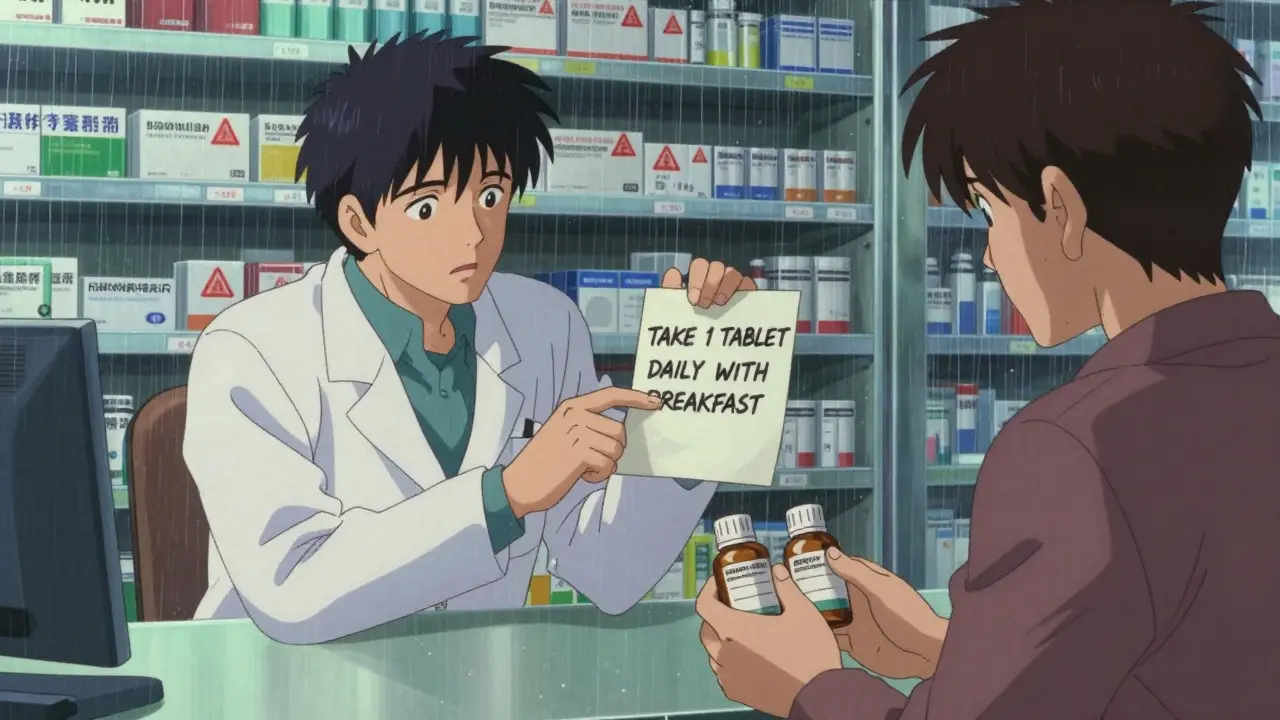
- Write it down. Take notes during your conversation. "Take 1 tablet daily, with breakfast. Maximum 2 per day. Wait 6 hours between doses if needed."
- Set reminders. Use your phone alarm. Set one for morning, one for night. The CDC says timers help prevent missed or double doses.
- Check online. Go to the FDA’s website or trusted sources like MedlinePlus. Search for the drug name + "Medication Guide." Compare what you were told with what’s officially listed.
- Ask your doctor. If your pharmacist can’t resolve it, call your prescriber. Say: "I got conflicting instructions. Can you clarify how this should be taken?"
And if you’re caring for someone else - a parent, a child, a partner - make sure they understand too. Use simple language. Don’t assume they remember what you heard. Repeat it. Show them the bottle. Demonstrate the timing.

Why This Matters More Than You Think
Medication errors don’t just happen in hospitals. They happen at home. Someone takes an extra pill because they thought "q.d." meant "every 12 hours." Someone skips a dose because they were told to "take at bedtime" but didn’t know if that meant 9 p.m. or midnight. Someone takes two painkillers because they didn’t know the daily limit.
And when you’re on multiple drugs - which 1 in 4 adults are - the risks multiply. One pill might affect how another works. Timing matters. Food matters. Even the order you take them in can change their effect.
Clear instructions aren’t about paperwork. They’re about safety. They’re about control. They’re about knowing you’re doing the right thing - not guessing.
Bottom Line: Your Health, Your Questions
You have every right to understand how to take your medicine. No label should leave you confused. No abbreviation should be used without explanation. No "as needed" should go without a clear limit.
Next time you get a prescription, don’t just take it. Ask. Write it down. Confirm it. And if you’re still unsure - ask again. Your body doesn’t understand jargon. It only understands clear, consistent, and repeated instructions.
It’s not just about following directions. It’s about protecting yourself.
What should I do if my medication instructions change between refills?
If the instructions on your new refill don’t match your previous one, don’t assume it’s a mistake. Call your pharmacist immediately. Differences can happen because of a switch in generic brands, updated guidelines, or a new manufacturer. Your pharmacist is required to explain why the instructions changed and confirm it’s still safe. Never start taking it differently without clarification.
Can I ask my doctor to write clearer instructions on the prescription?
Yes, absolutely. You can ask your doctor to write "daily" instead of "q.d.," or "take 1 tablet every 12 hours" instead of "BID." Many doctors now do this by default. If they don’t, say: "Could you please write out the full instructions? I want to make sure I take it correctly." This is a standard request and will be taken seriously.
Is it safe to take "as needed" medications more than once a day?
Not unless you know the limit. "As needed" doesn’t mean "whenever you feel like it." It means "when you need it, but not more than X times per day." For example, acetaminophen (Tylenol) is often labeled "take 1 tablet as needed for pain, up to 4 times daily." If you don’t know the max, you risk liver damage. Always ask: "What’s the most I can take in 24 hours?"
Why do some medications need to be taken at bedtime?
Timing affects how well a drug works. Cholesterol-lowering drugs like statins are taken at night because your liver produces most cholesterol while you sleep. Blood pressure meds taken at night may better control morning spikes. Sleep aids are taken before bed because they cause drowsiness. Always ask: "Is there a reason this should be taken at a certain time?"
What if I can’t reach my pharmacist or doctor when I have questions?
If you’re unsure and can’t reach your provider, don’t guess. Stop taking the medication until you get clear instructions. In the meantime, call a trusted pharmacy - even if you didn’t get the script there - and ask for help. Many pharmacies offer free medication reviews. You can also use the FDA’s MedWatch portal or trusted sites like MedlinePlus to check official drug info. Your safety is more important than waiting.
Ferdinand Aton
March 7, 2026 AT 16:10William Minks
March 7, 2026 AT 22:41Jeff Mirisola
March 8, 2026 AT 14:30amber carrillo
March 10, 2026 AT 00:41Tim Hnatko
March 10, 2026 AT 21:09Aaron Pace
March 12, 2026 AT 15:34Joey Pearson
March 14, 2026 AT 02:02Roland Silber
March 15, 2026 AT 15:51Patrick Jackson
March 16, 2026 AT 04:20Adebayo Muhammad
March 17, 2026 AT 15:45Pranay Roy
March 17, 2026 AT 20:26Joe Prism
March 17, 2026 AT 22:16Bridget Verwey
March 18, 2026 AT 18:02