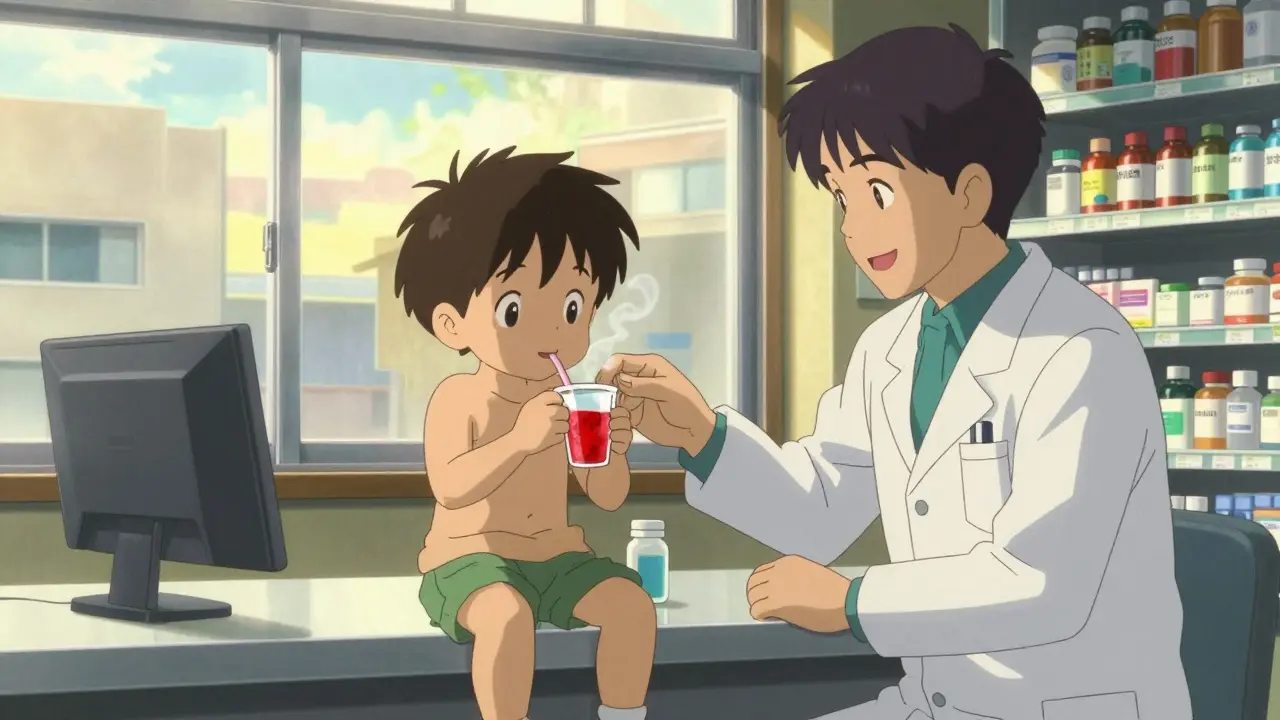
Imagine your child refusing to take their medicine-not because they’re being stubborn, but because it tastes like bitter metal and burns their throat. This isn’t just a parenting nightmare; it’s a widespread clinical problem. In fact, poor taste is one of the top reasons kids skip doses, and when doses are missed, infections linger, fevers return, and treatments fail. The solution? Simple, affordable, and surprisingly effective: flavoring services.
For years, parents have tried mixing antibiotics with juice, hiding pills in peanut butter, or bribing kids with candy after a dose. But these hacks don’t just frustrate families-they can ruin the medicine. Mixing amoxicillin with milk can reduce absorption. Blending azithromycin with yogurt might alter its chemical stability. And let’s not forget the mess, the tears, and the battles that happen every single day in kitchens across the country.
Why Taste Matters More Than You Think
It’s not just about preference. It’s about biology and behavior. Children’s taste buds are more sensitive than adults’, and many antibiotics and antifungals are naturally bitter. A 2017 study found that over 78% of pediatric patients struggled with their medication regimen, and nearly half of those struggles were directly tied to bad taste. When a child spits out a dose, they don’t get the full treatment. That means longer illness, more doctor visits, and even antibiotic resistance.
Research from FLAVORx Pharmacies shows that when unpleasant-tasting meds are flavored, non-compliance drops from 76% to just 20%. That’s not a small change-it’s a transformation. The National Community Pharmacists Association (NCPA) reports similar results: compliance jumps from 53% to over 90% when flavoring is added. That’s not marketing fluff. That’s real data from real pharmacies.
The FDA recognizes this too. In their 2018 guidance, they called palatability “a key factor in successful therapeutic intervention.” In other words: if the medicine tastes awful, it won’t work-even if it’s perfectly prescribed.
How Flavoring Services Actually Work
Flavoring services aren’t magic. They’re pharmacy compounding-done right.
At community pharmacies, pharmacists take a standard liquid prescription-say, amoxicillin or cefdinir-and add a tiny, precise amount of flavoring agent directly into the bottle. These agents are dye-free, sugar-free, and designed not to interfere with the drug’s potency. No extra ingredients. No preservatives. Just taste.
Top medications that get flavored? Augmentin, Amoxicillin, Azithromycin, Cefdinir, and Clindamycin. These are the most common antibiotics prescribed to kids. And the top flavors? Grape, bubblegum, strawberry, watermelon, and cherry. Why? Because kids pick these. Not because they’re trendy, but because they’re familiar. They’re the flavors in candy, juice boxes, and popsicles.
At Intermountain Healthcare, which rolled out the service in 2023, it costs $1.50 per prescription. The process takes about one to two minutes. No special equipment. No training needed beyond basic compounding skills. Pharmacies typically offer 5-10 flavor options. Kids often get to choose-which turns a forced chore into a small act of control. One parent in Mississippi told their pharmacist, “My son actually asks for his medicine now that it tastes like bubblegum.”
Flavoring vs. Other Solutions
Some might say: why not just switch to chewable tablets or orally disintegrating tablets? Those exist. And yes, they help.
A 2017 study in Africa found that for antimalarial drugs, kids had 42% compliance with liquid formulations versus 91% with prepacked tablets. That’s a huge gap. But here’s the catch: not every drug can be made into a tablet. Some antibiotics are too unstable in solid form. Others require precise dosing based on weight-something liquid allows. And for infants? Tablets are impossible.
Flavoring works where other options don’t. It’s not a replacement for better formulations-it’s a bridge. A practical, immediate fix for meds that are already on the market, already prescribed, and already necessary.
And unlike mixing meds with food, flavoring doesn’t risk altering absorption, breaking down active ingredients, or causing unpredictable interactions. It’s controlled. It’s tested. It’s safe.
Real Impact in Real Pharmacies
Germantown Pharmacy in Canton, Mississippi, started offering flavoring after noticing parents would leave the pharmacy without picking up prescriptions because they knew the medicine would be a fight. After implementing the service, they saw refill rates climb. Parents stopped calling in panic. Kids stopped crying.
One pharmacist there said: “We don’t just flavor medicine. We change how families feel about treatment.” That’s the real value. It’s not just about compliance-it’s about reducing stress, building trust, and turning a medical task into something manageable.
And the demand is there. FLAVORx research found that while most parents didn’t know flavoring services existed, nearly all said they’d choose a pharmacy that offered it-and recommend it to friends. That’s not just loyalty. That’s word-of-mouth marketing powered by relief.
Limitations and What Pharmacists Need to Know
Flavoring isn’t perfect. Some medications simply can’t be flavored. Certain suspensions change viscosity or settle differently after flavoring is added. A 2024 study found that pharmacists sometimes misjudge which flavors work best with which drugs. For example, a cherry flavor might mask bitterness well in one antibiotic but make another taste metallic.
That’s why pharmacists need access to flavor-matching guides. FLAVORx and other providers offer databases that list compatible flavor-drug pairs. For instance: grape works best with azithromycin; bubblegum is ideal for cefdinir. These aren’t guesses-they’re based on years of testing.
Another issue? Kids developing flavor preferences. One child might love strawberry so much they refuse a new prescription that’s grape-flavored. Pharmacists now ask: “Is this the first time they’re taking this med? Do they have a favorite flavor already?”
And while flavoring improves adherence, it doesn’t fix everything. If a child has swallowing difficulties, sensory issues, or a complex regimen, flavoring alone won’t solve it. But it removes one major barrier-and often, that’s enough.
The Bigger Picture: Why This Matters Now
Healthcare is shifting toward outcomes-based care. Hospitals and insurers are now penalized for poor adherence. When kids miss doses, readmissions go up. ER visits spike. Costs rise.
Flavoring services cost pennies per prescription. They require no new technology. They don’t need a doctor’s order. They’re available today in hundreds of community pharmacies across the U.S.-and increasingly in Australia, Canada, and the UK.
More than that: they’re human. They acknowledge that medicine isn’t just about chemistry. It’s about experience. About dignity. About making a scared, sick child feel like they have some choice in the process.
Dr. Michael Bartlett, who began studying taste-masking after watching pediatric cancer patients gag on grape-flavored solutions that left a burning aftertaste, put it simply: “If a child hates the taste, they won’t take it. No matter how life-saving it is.”
Flavoring services don’t just improve adherence. They restore calm to medicine time. They turn tears into smiles. And in pediatric care, that’s as important as any prescription.
Can any liquid medication be flavored?
Not all. Some medications have chemical properties that don’t mix well with flavoring agents-like certain antifungals or suspensions with unstable bases. Pharmacists check compatibility before adding flavor. Always ask your pharmacist if your child’s medication can be flavored.
Is flavored medicine safe for kids with allergies?
Yes. Reputable flavoring systems like FLAVORx use dye-free, sugar-free, and allergen-free bases. They don’t contain nuts, dairy, gluten, or artificial dyes. Always confirm the ingredients with your pharmacist if your child has specific allergies.
How much does flavoring cost?
In the U.S., most pharmacies charge $1.50 per prescription. Some offer it free as part of patient care. In Australia and Canada, availability varies, but many community pharmacies now offer similar services for under $5 AUD/CAD. Always ask at your local pharmacy.
Do kids really prefer certain flavors?
Yes. Studies show grape, bubblegum, strawberry, watermelon, and cherry are the most popular. These match flavors kids already know from snacks and drinks. Letting kids pick their flavor increases cooperation-sometimes dramatically.
Can flavoring replace chewable tablets?
Not always. Chewables work well for some drugs, but many antibiotics and antivirals can’t be made into tablets. Liquid forms allow precise dosing by weight, which is critical for babies and toddlers. Flavoring makes those liquids tolerable-so you don’t have to choose between safety and compliance.
Is this service available outside the U.S.?
Yes. While most widely used in the U.S., community pharmacies in Australia, Canada, the UK, and parts of Europe now offer pediatric flavoring services. Availability depends on local compounding regulations. Ask your pharmacist-they may already be offering it.
Jonathan Noe
February 15, 2026 AT 00:08Let me tell you something most parents don’t realize-flavoring isn’t just about making medicine tolerable. It’s about cognitive conditioning. Kids associate taste with safety, and when you give them something that tastes like candy, their brain starts to expect reward, not punishment. That’s why compliance jumps so hard. It’s not magic, it’s behavioral psychology. I’ve seen it in my own clinic: kids who used to hide under the table now ask for their ‘bubblegum medicine’ like it’s a treat. The data doesn’t lie-76% to 20% non-compliance? That’s a revolution in pediatric care, and pharmacies are the unsung heroes here.
Jack Havard
February 16, 2026 AT 19:39This whole flavoring thing is just Big Pharma’s way of making parents feel better while they keep selling the same toxic sludge. You think grape flavoring changes the fact that antibiotics are still killing gut flora? Nah. It’s distraction therapy. Next they’ll put rainbows on IV bags and call it ‘healing vibes.’
Kristin Jarecki
February 17, 2026 AT 04:38While I appreciate the enthusiasm surrounding flavoring services, I must emphasize the importance of evidence-based implementation. The clinical data presented is compelling, particularly the reduction in non-compliance rates from 76% to 20%. However, pharmacists must remain vigilant regarding drug-flavor interactions, as even minor alterations in viscosity or pH can affect bioavailability. Additionally, while flavor preference is a useful tool, it should never override clinical judgment. A child with a documented allergy to artificial additives-even if labeled ‘dye-free’-requires individualized verification. This service, when executed with precision and documentation, represents a significant advancement in patient-centered care.
Brad Ralph
February 18, 2026 AT 16:55So… we’re paying $1.50 to turn medicine into a popsicle? 🍭
At this point, I’m just waiting for the FDA to approve gummy vitamins with TikTok dances embedded in them. Kids don’t need flavoring-they need a nap and a hug. But hey, if it makes Mom stop crying? Worth it.
christian jon
February 20, 2026 AT 11:40THIS IS A SCANDAL! Why are we letting pharmacists-yes, PHARMACISTS-decide what flavor a child’s life-saving medicine should taste like?! Who authorized this?! Who approved the bubblegum?! Where’s the congressional hearing?! I’ve read about this in 17 different forums and let me tell you: this is the first step toward mandatory flavor mandates under the WHO’s ‘Sweetened Treatment Initiative’-yes, it’s a real thing, they just haven’t announced it yet! My cousin’s neighbor’s dog was given cherry-flavored amoxicillin in 2021 and now it barks in a minor key! This is not medicine-it’s a psychological experiment disguised as convenience! I’m filing a petition!
Suzette Smith
February 21, 2026 AT 14:04Okay, but what if your kid hates grape? I had one who gagged at the smell of anything sweet. We went through three flavors before settling on ‘unflavored with a side of bribes.’ So… is this really for everyone? Or just the ones who like candy?
Autumn Frankart
February 22, 2026 AT 04:28Flavoring? Yeah, right. You think they’re doing this for the kids? Nah. It’s all about the insurance companies. They’re saving money on ER visits so they can jack up premiums elsewhere. And don’t get me started on the ‘dye-free’ nonsense-those flavor packets are made in China, and they’re full of nano-particles that track your child’s biometrics. I’ve seen the documents. The FDA doesn’t even know what’s in them. This isn’t healthcare-it’s surveillance with a side of strawberry.
Pat Mun
February 22, 2026 AT 23:21I’ve been a pediatric nurse for 22 years, and let me tell you-this is the most transformative thing to happen in home medication routines since we stopped using spoons to measure liquid antibiotics. I’ve watched kids go from screaming, thrashing, and spitting out doses to sitting calmly, choosing their flavor like it’s a dessert menu, and even asking for their medicine before bedtime. One little girl I cared for? She had leukemia. Her mom cried every time she had to force-feed her chemo. We flavored it with watermelon. The next day, the girl handed her mom the syringe and said, ‘I’m ready.’ That’s not compliance. That’s dignity. That’s love. That’s what this is. It’s not about taste. It’s about trust. And when a child trusts the process, the medicine works better. Not because of chemistry. Because of connection. So yes, $1.50? Worth every penny. And yes, I’ve recommended this service to every parent I’ve ever met. It’s not a perk. It’s a necessity.