
When a hospital decides which drugs to stock, it’s not just about what’s on the market-it’s about cost, safety, and clinical fit. Behind every medication on a hospital shelf is a complex decision made by a Pharmacy and Therapeutics (P&T) committee. These committees don’t just pick the cheapest option. They weigh bioequivalence, supply reliability, nursing workload, and even how a drug behaves in critically ill patients. This is hospital formulary economics in action: a system built to balance clinical outcomes with financial reality.
What Is a Hospital Formulary?
A hospital formulary is a living list of approved medications. It’s not a static catalog. It’s updated quarterly, sometimes monthly, based on new evidence, price changes, and supply issues. Unlike retail pharmacies that follow Medicare Part D rules requiring at least two drugs per therapeutic category, hospitals operate under their own standards. Most use closed or partially closed formularies-meaning only pre-approved drugs can be used unless a doctor gets special permission. About 78% of academic medical centers use this model, compared to just 42% of commercial insurers.
The formulary typically includes 300 to 1,000 drug dosage forms. Each one has been reviewed for safety, effectiveness, and cost. The goal? To ensure every drug used delivers the best possible outcome at the lowest sustainable price. This isn’t about cutting corners. It’s about avoiding waste-like buying a brand-name drug when a generic works just as well, or stocking a drug that keeps running out.
How Generics Get Into the Formulary
Not all generics are created equal. A drug approved by the FDA as bioequivalent doesn’t automatically make it onto a hospital formulary. P&T committees demand more. They look at real-world data: How does the generic perform in ICU patients? Does it dissolve the same way? Is the tablet size easy for nurses to handle? Can it be stored without refrigeration?
The process starts when a manufacturer submits a formal dossier-often called an AMCP dossier-that includes clinical studies, pharmacology data, and cost analysis. Committees then compare it to the brand-name version and other available generics. They don’t just check the label. They dig into bioequivalence studies, especially for complex drugs like inhalers, injectables, or anticoagulants. A 2023 survey found that 68% of hospital pharmacists struggle with therapeutic equivalence for these types of products.
One key insight? Regulatory approval is the floor, not the ceiling. A drug can be FDA-approved but still fail hospital standards. For example, a generic anticoagulant might have the same active ingredient, but if it causes more variability in blood levels among patients, it’s a no-go. Dr. Michael Rodriguez from Johns Hopkins said switching to a generic anticoagulant once led to more frequent lab tests and extra nursing time-costs that erased the savings from the lower drug price.
The Tier System: How Hospitals Rank Drugs
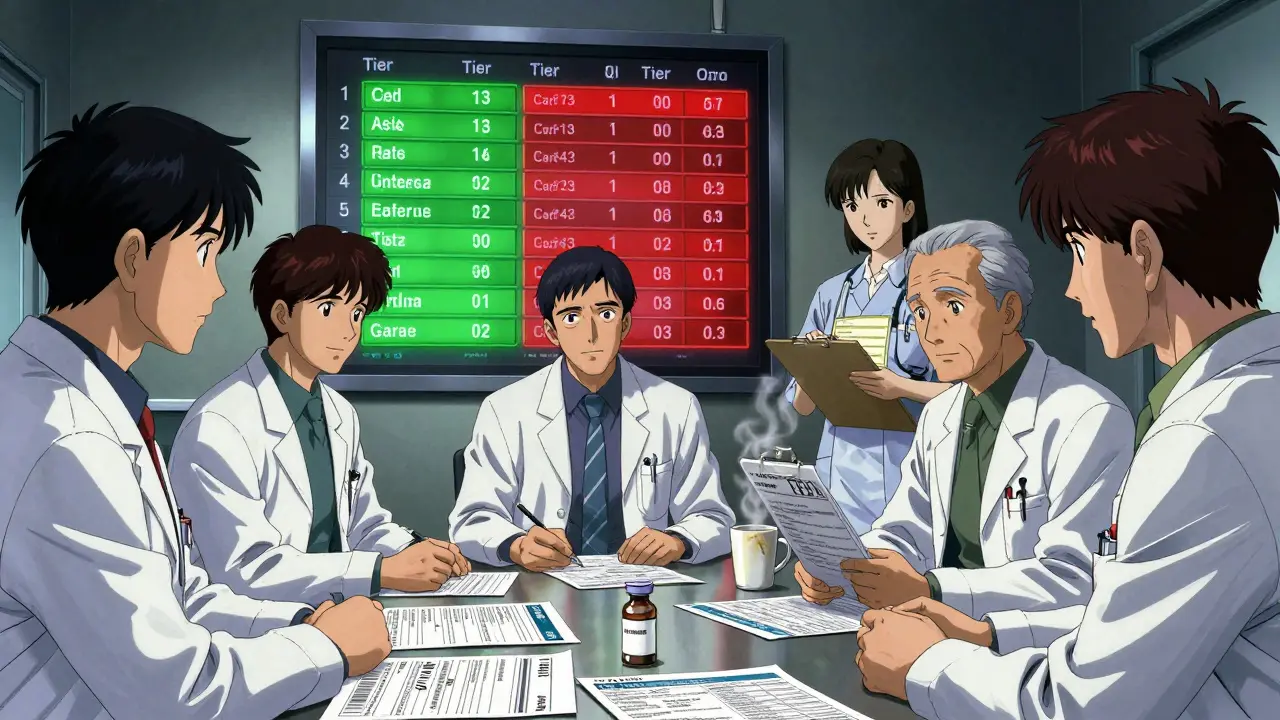
Hospitals use tiered formularies to guide prescribing. Think of it like a pricing ladder:
- Tier 1: Preferred generics-lowest cost, lowest patient copay, first-line choice.
- Tier 2: Non-preferred generics or preferred brands-moderate cost-sharing.
- Tier 3: Non-preferred brands-higher cost, requires prior authorization.
- Tiers 4-5: Specialty drugs-expensive, often percentage-based coinsurance.
This system isn’t just about patient out-of-pocket costs. It’s a tool to steer prescribing. If a drug is on Tier 1, clinicians are more likely to choose it. If it’s on Tier 3, they need to justify why they’re not using the cheaper option. The goal is to make the right choice the easy choice.
Why Hospitals Care More Than Retail Pharmacies
There’s a big difference between what works in a retail pharmacy and what works in a hospital. In retail, patients store their own meds, take them at home, and might forget doses. Hospitals control everything: who gets the drug, when, how, and under what conditions. That changes the game.
For example, a generic inhaler might be fine for an outpatient with asthma. But in a hospital, if the inhaler’s propellant or particle size differs slightly from the brand, it could mean poor lung delivery for a patient on a ventilator. That’s not a minor issue-it’s a safety risk. Hospitals also deal with IV medications, critical care dosing, and rapid-response scenarios where every second counts. A generic that’s slightly slower to dissolve could delay treatment.
Plus, hospitals don’t have to follow CMS rules. They can limit options to avoid confusion. A retail pharmacy might stock five different blood pressure generics. A hospital might pick one-because that’s all the staff needs to know.
The Hidden Costs of Cheap Generics
It’s easy to assume that the lowest-priced generic wins. But that’s not always true. The real cost isn’t just the list price-it’s the net cost after rebates, service agreements, and supply chain disruptions.
Dr. Emily Chen from Massachusetts General Hospital points out that some generics come with heavy rebates from manufacturers. The list price might look great, but if the hospital has to pay for extra storage, training, or monitoring to use it safely, the savings vanish. And if the supplier has a shortage? The hospital has to buy a non-formulary version at 3-5 times the cost.
That’s why 84% of hospital pharmacists reported at least one critical generic shortage in Q3 2023. When a key generic runs out, they’re forced to use a brand-name drug or an alternative that’s not on the formulary. That costs more, takes time, and sometimes puts patients at risk.
On the flip side, Mayo Clinic saved $1.2 million a year by switching to generics for cardiovascular drugs-after setting up strict monitoring protocols. That’s the key: you can’t just swap a drug and call it a day. You need systems to track outcomes.

Who Makes the Decisions?
P&T committees aren’t made up of administrators. They’re led by pharmacists, doctors, and nurses with clinical expertise. At least half the members should be clinical pharmacists, according to the American Society of Health-System Pharmacists. These people understand bioequivalence studies, pharmacokinetics, and how drugs behave in real patients.
But training takes time. New members need 6-9 months to get up to speed. They have to learn how to read FDA bioequivalence data, understand rebate structures, and interpret clinical trials. Many hospitals still lack automated systems to flag formulary violations. Only 37% have formulary alerts built into their electronic health records. That means 15-20% of prescriptions still go against formulary guidelines-often because the clinician didn’t know better.
The Future: Transparency, Complexity, and Change
The landscape is shifting. The 2023 Consolidated Appropriations Act will require drugmakers to disclose pricing and rebate details starting in January 2025. That’s going to shake up formulary decisions. Hospitals will finally see what’s really being paid behind the scenes.
The FDA’s GDUFA III program is investing $4.3 million annually to speed up approval of complex generics-like injectables and inhalers. By 2026, more of these drugs should be available, reducing shortages and expanding options.
Some hospitals are even starting to use pharmacogenomics. If a patient has a genetic variation that affects how they metabolize a drug, the formulary might favor one generic over another based on that data. Twenty-eight percent of academic centers are already doing this.
But challenges remain. In November 2023, there were 298 active generic drug shortages-the highest ever recorded. Hospitals can’t afford to rely on a single supplier. They need backup plans, flexible formularies, and strong supplier relationships.
What Works: Real-World Success Stories
Cleveland Clinic cut generic acquisition costs by 18.3% without hurting patient outcomes. How? They created a therapeutic interchange committee that developed clear, evidence-based protocols. Every switch from brand to generic was tracked. Nurses were trained. Labs were adjusted. Patients were monitored.
That’s the model: not just swapping drugs, but changing systems. Successful hospitals don’t just save money. They improve safety, reduce errors, and build trust with clinicians.
It’s not about being cheap. It’s about being smart.
What’s the difference between a hospital formulary and a retail pharmacy formulary?
Hospital formularies are typically closed or partially closed, meaning only approved drugs can be used without special permission. They focus on inpatient care, where dosing, administration, and monitoring are controlled by staff. Retail formularies are often open and designed for outpatient use, with more emphasis on patient convenience, cost-sharing, and adherence. Hospitals don’t have to follow CMS rules like Medicare Part D, which requires at least two drugs per therapeutic category.
Why can a generic drug approved by the FDA still be rejected by a hospital formulary?
FDA approval only confirms bioequivalence under controlled conditions. Hospitals look deeper: Does the drug behave the same in critically ill patients? Are the tablet size, dissolution rate, or delivery mechanism clinically equivalent? For complex drugs like inhalers or injectables, even small differences can impact safety. A generic might be chemically identical but cause more variability in blood levels, leading to more lab tests or adverse events-costs that erase savings.
How do rebates affect generic drug selection in hospitals?
Rebates can make a drug appear cheaper than it is. A generic with a low list price might come with a rebate that requires the hospital to meet volume targets, use specific dispensing systems, or pay for administrative services. The net cost after rebates and service fees can be higher than a slightly more expensive drug with no strings attached. Hospitals now track net cost, not just list price, to avoid hidden expenses.
What role do pharmacists play in hospital formulary decisions?
Pharmacists are central. At least half of P&T committee members should be clinical pharmacists. They evaluate bioequivalence data, interpret clinical studies, assess drug safety in complex populations, and analyze cost-effectiveness. They also train staff, monitor outcomes after drug switches, and troubleshoot shortages. Their expertise turns a purchasing decision into a clinical one.
How do drug shortages impact hospital formularies?
Drug shortages force hospitals to use non-formulary alternatives, often at much higher prices. In Q3 2023, 84% of hospital pharmacists reported at least one critical generic shortage. When a key drug runs out, clinicians may have to use a brand-name version or a less effective substitute, increasing costs and potentially compromising care. Hospitals are now building more flexible formularies and maintaining backup suppliers to reduce these risks.
Choosing generics isn’t about price tags-it’s about precision. Hospitals are under pressure to cut costs, but they can’t afford to cut corners. The best formularies don’t just save money-they protect patients, support staff, and ensure that every drug used does exactly what it’s supposed to.