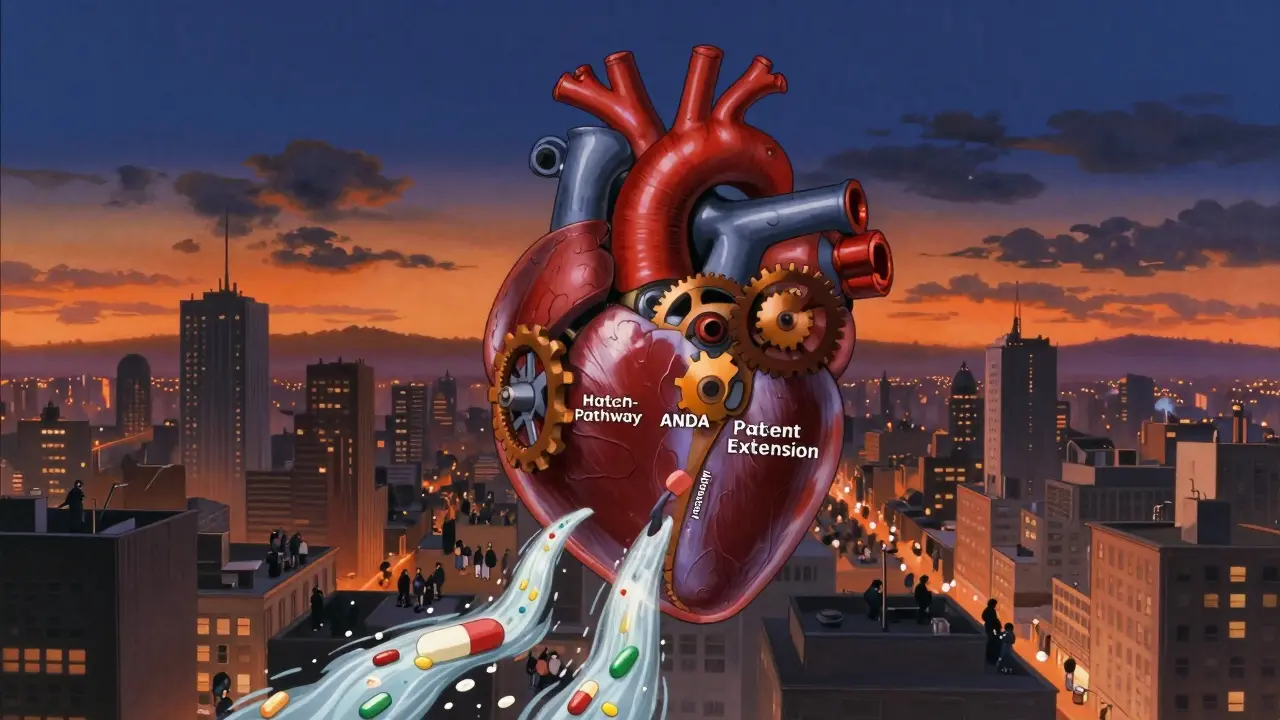
The U.S. generic drug market didn’t just happen. It was built by law - specifically, the Hatch-Waxman Act, passed in 1984. Before this law, generic drugs were rare. Companies couldn’t test them until after a brand-name drug’s patent expired, and even then, they had to repeat expensive clinical trials. That meant fewer generics, higher prices, and slower access for patients. The Hatch-Waxman Act changed all of that. It created a legal pathway for generic drugs to reach the market faster, cheaper, and legally - without undermining innovation. Today, 9 out of 10 prescriptions filled in the U.S. are for generics. That’s not an accident. It’s the direct result of this one law.
What the Hatch-Waxman Act Actually Did
The full name of the law is the Drug Price Competition and Patent Term Restoration Act of 1984. It sounds bureaucratic, but its purpose was simple: fix a broken system. Before 1984, generic manufacturers were stuck. A 1984 Supreme Court case, Roche v. Bolar, ruled that testing a patented drug before its patent expired was illegal - even if the goal was to get approval the moment the patent ended. That meant generics couldn’t start development until the patent expired. For a drug with a 20-year patent, that meant waiting a decade or more just to get started.
The Hatch-Waxman Act flipped that rule. It created what’s called a "safe harbor" - a legal exception that lets generic companies test patented drugs during the patent term, as long as the only purpose is to gather data for FDA approval. This small change cut years off the timeline. Suddenly, generics could begin development up to five years before a patent expired. That’s how we went from a handful of generic approvals per year to over 770 in 2019.
But the law didn’t just help generics. It also gave brand-name drug companies something they wanted: the chance to extend their patent life. When a company spends years getting FDA approval for a new drug, that time counts against its 20-year patent. The Hatch-Waxman Act allowed innovators to apply for a patent extension - up to five years - to make up for time lost in regulatory review. The average extension granted? About 2.6 years. That kept innovation profitable while still letting generics enter after the extended term.
The ANDA Pathway: How Generics Got Approved Without Repeating Trials
The real engine behind generic drug approval is the Abbreviated New Drug Application, or ANDA. Before Hatch-Waxman, every new drug - even a copy - had to go through the same full clinical trial process as the original. That cost $1 billion or more and took 10+ years. The ANDA changed that.
Instead of proving safety and effectiveness from scratch, generic manufacturers only need to show their drug is bioequivalent to the brand-name version. That means it delivers the same amount of active ingredient into the bloodstream at the same rate. No need for large-scale trials on patients. Just lab tests, chemical analysis, and a few small studies. The FDA estimates this cuts development costs by about 75%. That’s why a generic drug can cost 85% less than the brand-name version.
The ANDA system also created the "Reference Listed Drug" - a single brand-name drug that all generics must match. Once a drug is approved and listed in the FDA’s Orange Book, any generic company can use it as their benchmark. This standardization made approval predictable. It also made it easier for companies to compete. By 2022, over 15,600 generic products had been approved under this pathway.
Patent Challenges and the 180-Day Exclusivity Rule
One of the most powerful - and controversial - parts of Hatch-Waxman is the Paragraph IV certification. When a generic company files an ANDA, it must check the Orange Book for patents on the brand-name drug. If it believes a patent is invalid or won’t be infringed, it can file a Paragraph IV certification. This triggers a legal showdown.
The brand-name company has 45 days to sue. If they do, the FDA is legally required to delay approval for 30 months - unless the court rules in favor of the generic sooner. This created a race. The first generic company to file a Paragraph IV challenge gets 180 days of exclusive marketing rights. No other generic can enter during that time. That incentive turned the ANDA process into a high-stakes game. Companies would literally camp outside FDA offices to be first in line.
But the system got gamed. By 2003, the FDA changed its rules to allow multiple companies to share the 180-day exclusivity if they filed on the same day. That helped, but it didn’t stop the next problem: patent thickets.
How Brand Companies Stretched Monopolies
Here’s where the law’s design started to unravel. Originally, innovator companies averaged about 3.5 patents per drug in 1984. By 2020, that number had jumped to 14. These aren’t all core patents. Many are "secondary patents" - on minor changes like a new pill coating, a slightly different dosage form, or a new use for the drug. These patents get listed in the Orange Book, and each one can trigger a 30-month delay.
This tactic is called "patent thickets." A brand company files 10 or 15 patents, knowing that even if one is challenged, others will keep generics out. A 2020 study found this delays generic entry by an average of 2.7 years. It’s legal - but it’s not what Hatch-Waxman intended.
Another tactic is "product hopping." A company slightly changes the drug - say, from a pill to a tablet - and patents the new version. Then they stop selling the old version, pushing patients to the new one. This resets the clock on generic competition. The FTC has documented 262 such cases between 2010 and 2022, mostly in oncology, immunology, and neurology drugs.
Then there’s "pay-for-delay." Sometimes, a brand company will pay a generic company to delay entering the market. These settlements were common between 2005 and 2012, affecting 10% of all patent challenges. The FTC says these deals cost consumers $3.5 billion a year in higher prices.
Real-World Impact: Costs, Access, and Market Shifts
The numbers speak for themselves. In 1984, generics made up less than 20% of prescriptions. Today, they’re 90%. But they only account for 18% of total drug spending. That’s because generics are cheap. The average brand-name drug costs $1,000 per month. The generic? $150. That’s why the U.S. healthcare system saves $313 billion every year thanks to generics.
But the savings aren’t evenly distributed. The top 10 generic manufacturers now control 62% of the market - up from 38% in 2000. Why? Because navigating Hatch-Waxman is expensive. A single Paragraph IV challenge can cost $15 million to $30 million. That’s why small companies can’t compete. Only big players have the lawyers, scientists, and resources to fight through the patent maze.
And the FDA’s workload has exploded. A typical ANDA submission now contains 30,000 to 50,000 pages of data. That’s more than a full-length novel. Before GDUFA (Generic Drug User Fee Amendments) started in 2012, the FDA took 36 months to review an application. Now, thanks to fees paid by generic companies, it’s down to 10 months. But 43% of submissions still get rejected on first review - often for minor paperwork errors.
Is the System Broken? What’s Being Done
Most experts agree: the core of Hatch-Waxman still works. It created a balance between innovation and access. But the loopholes have become too big. In 2022, Congress passed the CREATES Act to stop brand companies from blocking generic companies from getting drug samples needed for testing. That was a start.
In 2023, the House passed the Preserve Access to Affordable Generics and Biosimilars Act - which would ban pay-for-delay deals outright. The FDA also issued new draft rules to tighten what patents can be listed in the Orange Book. If these changes stick, generic entry could speed up by 1.4 years on average, saving $45 billion a year by 2030.
But there’s pushback. The Biotechnology Innovation Organization warns that too many restrictions could cut new drug approvals by 12-15%. Japan saw a similar drop after it reformed its system in 2018. The challenge isn’t to scrap Hatch-Waxman - it’s to fix its abuses.
What’s Next for Generic Drugs
The future of generics depends on two things: enforcement and transparency. The FDA needs to be stricter about patent listings. Courts need to stop delaying cases unnecessarily. And Congress needs to keep closing loopholes.
Right now, the system is still the best we have. It’s not perfect. But without Hatch-Waxman, most Americans wouldn’t be able to afford their prescriptions. The law didn’t just create a market - it created a public health tool. The next chapter won’t be about tearing it down. It’ll be about making sure it works the way it was meant to: for patients.
What is the ANDA pathway?
The Abbreviated New Drug Application (ANDA) pathway is the FDA process that allows generic drug manufacturers to seek approval without repeating costly clinical trials. Instead, they must prove their product is bioequivalent to a brand-name drug already on the market - meaning it delivers the same amount of active ingredient at the same rate. This reduces development time and cost by about 75%, making generics affordable and widely available.
How does the Hatch-Waxman Act extend brand-name drug patents?
The Act allows innovator companies to apply for patent term restoration to make up for time lost during FDA review. The patent clock stops during clinical trials and regulatory approval, so companies can extend their patent by up to five years - though the average extension granted is about 2.6 years. This helps recover R&D investment while still allowing generics to enter after the extended term expires.
Why do generic companies file Paragraph IV certifications?
A Paragraph IV certification is a legal statement by a generic manufacturer that a patent listed in the FDA’s Orange Book is invalid or won’t be infringed. Filing this triggers a 30-month automatic stay on FDA approval, giving the brand company time to sue. But if the generic wins the lawsuit, it gets 180 days of market exclusivity - the incentive that drives most patent challenges.
What are "patent thickets" and how do they delay generics?
Patent thickets occur when brand-name companies file dozens of secondary patents - on minor changes like dosage form, coating, or use - to create legal barriers. Each patent can trigger a 30-month delay if challenged. With 14 patents per drug on average today (up from 3.5 in 1984), generics can be blocked for years even after the original patent expires, delaying competition and keeping prices high.
How much money has the Hatch-Waxman Act saved U.S. healthcare?
Between 1991 and 2011, the Act saved $1.18 trillion in drug spending. In 2022 alone, generics saved the U.S. healthcare system $313 billion. That’s because generics cost 80-85% less than brand-name drugs, and they now make up 90% of prescriptions filled. Without Hatch-Waxman, most Americans would pay far more for essential medications.