
A goiter isn’t just a bump on the neck-it’s a sign your thyroid is working overtime. This gland, shaped like a butterfly and tucked just below your Adam’s apple, normally weighs less than a tablespoon of sugar. But when it swells, it can grow to twice or even five times its normal size. You might notice it when buttoning your shirt, or when someone points out a visible lump. Sometimes, it doesn’t show up at all until you start having trouble swallowing, breathing, or your voice gets hoarse. The cause? Often, it’s something simple: not enough iodine. But not always.
What Causes a Goiter?
For most people around the world, the answer is straightforward: iodine deficiency. About 90% of goiter cases in areas without iodized salt are linked to not getting enough of this mineral. The thyroid needs iodine to make hormones that control metabolism, body temperature, and energy. Without it, the gland keeps trying to produce more hormones-so it grows bigger, like a muscle that’s been overworked.
In the U.S., where iodized salt has been common since the 1920s, the story changes. Here, autoimmune diseases are the main culprits. Hashimoto’s thyroiditis, where the immune system attacks the thyroid, is the number one cause. It slowly destroys the gland, causing it to swell before eventually shrinking. Another common cause is Graves’ disease, which overstimulates the thyroid, leading to a toxic goiter that produces too much hormone.
Other triggers include thyroid nodules, inflammation, or even certain medications. Pregnancy can also cause temporary goiter due to hormonal shifts. But no matter the cause, the result is the same: an enlarged gland that can press on your windpipe, esophagus, or vocal cords.
The Iodine Connection
Iodine isn’t something your body makes. You have to get it from food or supplements. The recommended daily amount for adults is 150 micrograms. Pregnant women need 220 mcg, and breastfeeding mothers need 290 mcg. That’s because the baby’s brain development depends on thyroid hormones made from iodine.
In the U.S., iodized salt gives you about 45 mcg per gram. So a half-teaspoon of salt gives you nearly all you need. Other sources include seafood, dairy, eggs, and some breads. But if you avoid salt, follow a strict vegan diet, or live in a region where soil lacks iodine, you might not be getting enough.
Back in the 1910s, Dr. David Marine tested this in Ohio schoolgirls. He gave them iodine supplements. Within a year, goiter rates dropped by 80%. That study changed public health forever. Today, salt iodization has cut global goiter rates by half since the 1990s. But 1.9 billion people still live in areas where iodine deficiency is common. That’s nearly a quarter of the world’s population.
How Much Iodine Should You Take?
If you have a goiter caused by iodine deficiency, supplementing with 150 mcg per day usually shrinks the gland by 30-40% in 6 to 12 months. That’s the standard dose recommended by the NIH and the American Thyroid Association. It’s not a quick fix-it takes time. The thyroid doesn’t shrink overnight. But with consistent intake, many people see their goiter disappear completely.
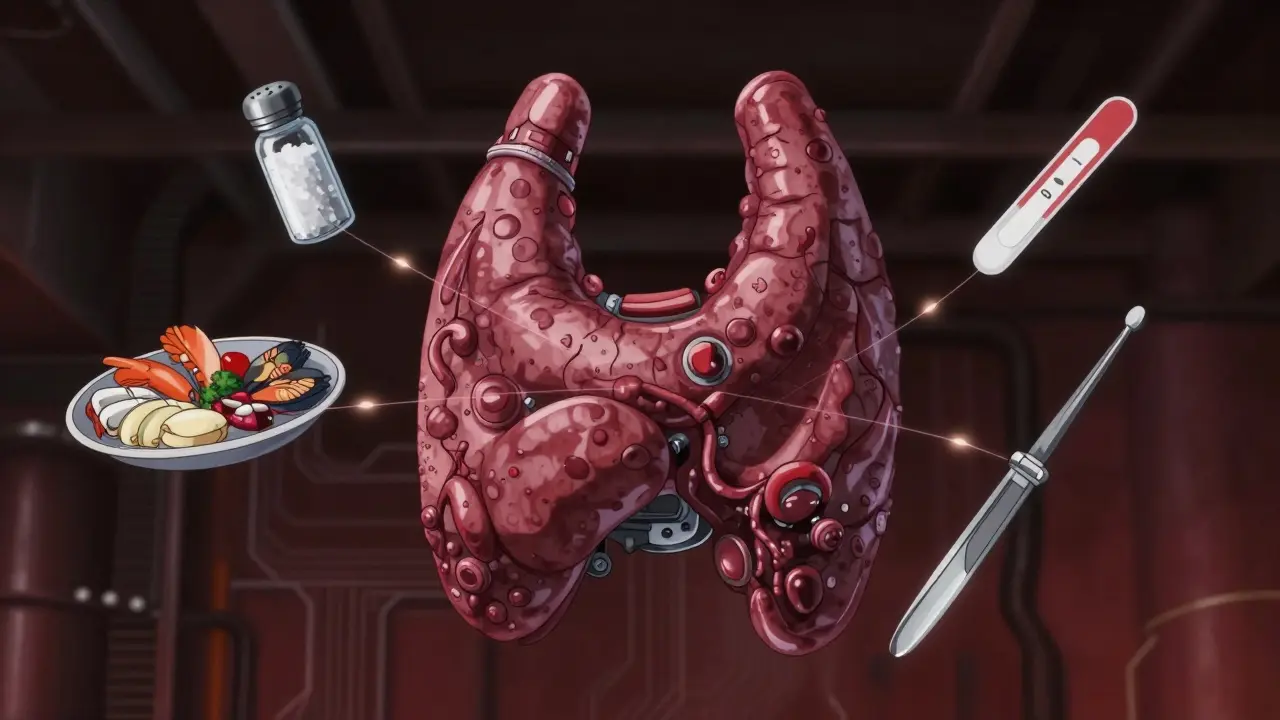
But here’s the catch: if your goiter isn’t from iodine deficiency, supplements won’t help. In fact, they can make things worse. If you have Hashimoto’s or Graves’ disease, extra iodine can trigger more inflammation or overproduction of hormones. That’s why testing matters. A simple blood test for TSH, T3, T4, and thyroid antibodies can tell you the root cause. Don’t start taking iodine pills just because you read about it.

Treatment Beyond Iodine
For Hashimoto’s-related goiters with low thyroid hormone levels, levothyroxine is the go-to treatment. It replaces what your thyroid can’t make. But it rarely shrinks the gland much-maybe 10-20%. That’s because the tissue becomes scarred over time. The goal here isn’t to shrink the goiter-it’s to restore hormone balance and stop further growth.
If you have a toxic goiter from Graves’ disease, doctors usually start with antithyroid drugs like methimazole. These block hormone production. Over 12 to 18 months, the gland shrinks by 40-60%. But this doesn’t cure the disease. Many people eventually need radioactive iodine or surgery.
Radioactive iodine is a one-time treatment that burns out overactive thyroid tissue. It reduces goiter size by 50-60%, but it almost always leads to permanent hypothyroidism. That means you’ll need to take thyroid hormone for the rest of your life. It’s effective, but not without trade-offs.
Surgery becomes necessary when the goiter is huge-over 80-100 mL-or when it’s causing breathing or swallowing problems. A total thyroidectomy removes 30-40 grams of tissue. That’s about the weight of a small apple. But recovery isn’t simple. About 15% of people experience voice changes, and 8% develop low calcium levels due to damage to nearby parathyroid glands. These risks are why surgery is reserved for serious cases.
What About Selenium?
You might hear about selenium helping thyroid health. It’s true that selenium is involved in hormone production and helps reduce inflammation. Some studies in Europe suggest it might help people with Hashimoto’s by lowering antibody levels. But a major 2021 Cochrane Review looked at 13 clinical trials and found no clear benefit for reducing goiter size. The odds of improvement were nearly the same with or without selenium. So unless you’re deficient in selenium-which is rare in the U.S.-supplements aren’t recommended for goiter treatment.
Who’s Most at Risk?
Women are three times more likely than men to develop goiter. After age 40, the risk climbs for everyone. If you have a family history of thyroid disease, you’re more vulnerable. So are people who’ve had radiation to the head or neck, or those living in iodine-poor regions like mountainous areas or flood-prone zones where soil washes away minerals.
In Australia, where iodine deficiency was once common, public health efforts since the 2000s have added iodine to bread and salt. Rates have dropped, but not disappeared. Pregnant women still need extra care. Many don’t get enough iodine from diet alone. That’s why prenatal vitamins in Australia now include 150 mcg of iodine.
What’s the Outlook?
If your goiter is from iodine deficiency, your prognosis is excellent. With proper supplementation, 70-85% of cases resolve within a year or two. No surgery. No medication. Just a daily pill or iodized salt.
But if it’s autoimmune, you’re looking at long-term management. About 60% of Hashimoto’s cases eventually lead to a shrunken, non-functional thyroid. That’s not a failure-it’s just the natural progression. The goal shifts from shrinking the goiter to keeping your hormones balanced.
Right now, researchers are digging into genetics. A 2023 NIH study called TRIPOD is tracking 5,000 people across 10 countries to find which genes affect thyroid size. Early results show 37 genetic markers linked to goiter risk. This could one day help predict who’s most likely to develop it-and how to prevent it before it starts.
What Should You Do?
- If you notice a neck lump, see a doctor. Don’t wait.
- Get blood tests for TSH, free T4, and thyroid antibodies. That’s the first step.
- If you’re pregnant or planning to be, make sure your prenatal vitamin has iodine.
- If you avoid salt, get iodine from seafood, dairy, or a supplement-150 mcg daily.
- Don’t self-prescribe iodine pills. Too much can cause problems too.
- Use iodized salt. It’s cheap, safe, and effective.
Goiter isn’t rare. It’s not scary. But it’s a signal. Pay attention to it. And treat the cause-not just the swelling.
Can iodine supplements shrink a goiter?
Yes-but only if the goiter is caused by iodine deficiency. In those cases, taking 150 mcg of iodine daily can reduce the size of the thyroid by 30-40% within 6 to 12 months. If the goiter is due to Hashimoto’s or Graves’ disease, iodine supplements won’t help and may even make it worse.
Is iodized salt enough to prevent goiter?
For most people, yes. One gram of iodized salt contains about 45 mcg of iodine. Since the daily requirement is 150 mcg, using salt in cooking and at the table typically covers your needs. People who avoid salt, follow strict vegan diets, or live in iodine-poor regions may need additional sources like dairy, eggs, or supplements.
Why do women get goiters more often than men?
Women are more likely to develop autoimmune thyroid disorders like Hashimoto’s and Graves’ disease, which are the leading causes of goiter in countries with iodized salt. Hormonal changes during pregnancy, menstruation, and menopause also stress the thyroid, making it more vulnerable to dysfunction. This biological difference explains why women make up about 75% of goiter cases.
Can you cure a goiter without surgery?
In many cases, yes. Goiters caused by iodine deficiency often resolve with supplements. Those caused by hypothyroidism can be managed with levothyroxine. Toxic goiters from Graves’ disease can be treated with antithyroid drugs or radioactive iodine. Surgery is only needed when the goiter is very large (over 80-100 mL) or causes breathing/swallowing problems.
Does selenium help reduce goiter size?
No strong evidence supports this. A 2021 Cochrane Review of 13 studies found no significant benefit from selenium supplements in reducing goiter size. While selenium plays a role in thyroid function, taking extra amounts doesn’t shrink the gland or improve outcomes for most people. It’s only recommended if you have a confirmed selenium deficiency, which is rare in most developed countries.
What happens if I ignore a goiter?
It depends on the cause. A small, non-toxic goiter from iodine deficiency may grow slowly and cause no problems. But if it’s due to an autoimmune condition or nodules, it could lead to hypothyroidism, hyperthyroidism, or compression of your windpipe or esophagus. In rare cases, a goiter can mask thyroid cancer. That’s why evaluation with blood tests and ultrasound is essential-even if you feel fine.
Nicholas Gama
March 8, 2026 AT 18:21Mary Beth Brook
March 10, 2026 AT 11:11Neeti Rustagi
March 11, 2026 AT 05:02Dan Mayer
March 11, 2026 AT 06:12Janelle Pearl
March 12, 2026 AT 20:20Ray Foret Jr.
March 14, 2026 AT 14:56Samantha Fierro
March 15, 2026 AT 17:27Robert Bliss
March 17, 2026 AT 12:24Peter Kovac
March 18, 2026 AT 16:39APRIL HARRINGTON
March 20, 2026 AT 12:33Leon Hallal
March 22, 2026 AT 02:16Judith Manzano
March 23, 2026 AT 22:23rafeq khlo
March 25, 2026 AT 01:37Tom Sanders
March 26, 2026 AT 23:36