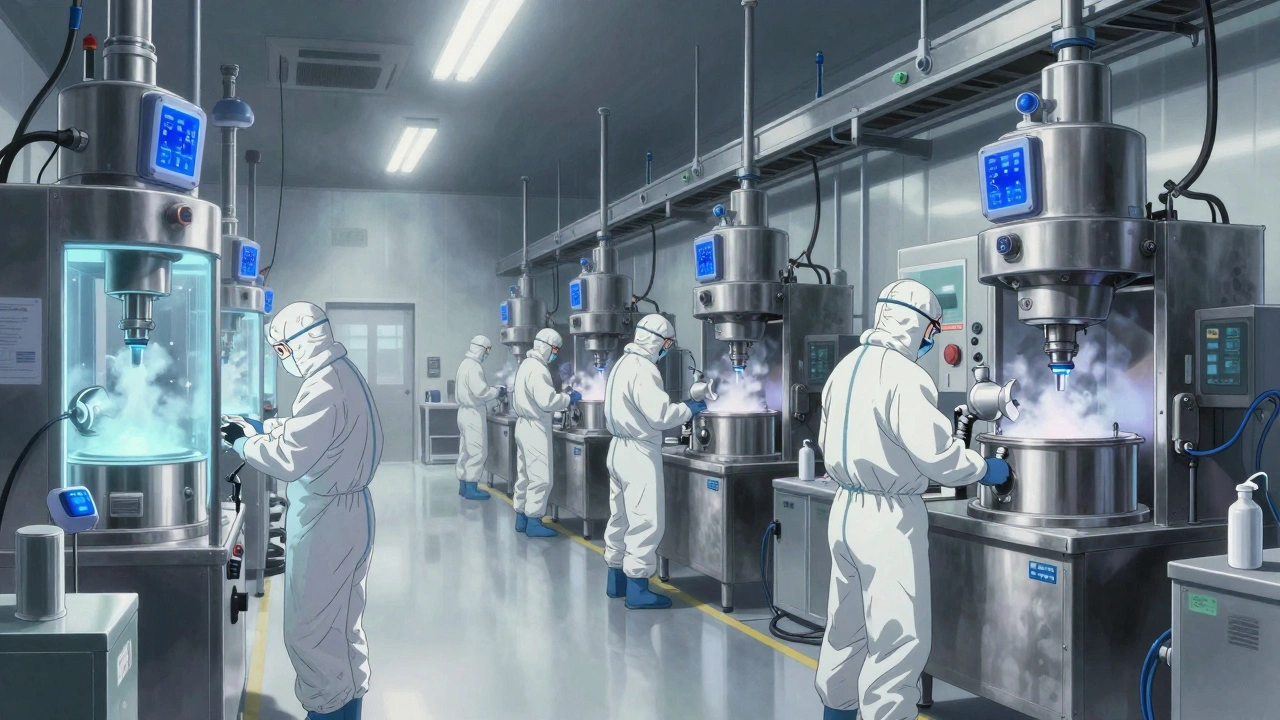
When you pick up a generic pill at the pharmacy, you expect it to work just like the brand-name version. But behind that simple promise is a high-stakes battle against invisible threats: dust, microbes, chemical residues, and human error. In generic drug manufacturing, contamination control isn’t just a checklist item-it’s the line between a life-saving medicine and a dangerous product.
Why Contamination Matters More in Generics
Generic drugs make up 90% of prescriptions filled in the U.S., but they account for only 22% of total drug spending. That means manufacturers operate on razor-thin margins. Cutting corners on cleanliness might seem like a way to save money, but it’s a gamble with deadly consequences. In 2020, a single chemical contaminant-nitrosamine-showed up in blood pressure meds like Valsartan. It wasn’t just one company. Twenty-two generic manufacturers had to recall products. The cost? Over $1.2 billion. The FDA issued 37% of all its warning letters that year for contamination issues. These aren’t hypothetical risks. They’re real, documented failures. Unlike brand-name companies that design drugs from scratch, generic manufacturers copy existing formulas. That means they often share equipment, facilities, and even raw materials with other products. One wrong move-like using the same blender for two different drugs without proper cleaning-and you risk turning a heart medication into something toxic.How Contamination Happens
Contamination isn’t always dirt or mold. It can be microscopic chemical traces, airborne particles, or bacteria from a worker’s skin. Here’s how it typically happens:- Cross-contamination: When residue from one drug gets into another. Even 1 nanogram per square centimeter-less than a grain of salt-can be dangerous for potent drugs like cancer treatments.
- Microbial growth: Bacteria or mold in water systems, air vents, or unclean surfaces. This is especially risky for injectables and sterile products.
- Raw material issues: Indian suppliers, who provide 40% of the world’s generic APIs, report 22% more contaminated raw materials than EU sources, according to EDQM data.
- Human error: A worker forgets to change gloves. Someone skips a cleaning step. A gown isn’t sealed right. Studies show 47% of contamination events trace back to people.
The Rules: CGMP and Beyond
The U.S. Food and Drug Administration enforces Current Good Manufacturing Practices (CGMP), set in place since the 1960s. But the rules have gotten much stricter. The 2004 FDA guidance and the 2022 EU GMP Annex 1 update turned contamination control into a science. Facilities must now meet ISO cleanroom standards:- ISO Class 5 (Grade A): For filling sterile products. No more than 3,520 particles larger than 0.5 micrometers per cubic meter of air.
- ISO Class 7 (Grade C): Background areas. Must have 20-60 air changes per hour.
- ISO Class 8 (Grade D): For packaging and less critical zones.

Technology That Makes a Difference
Old-school methods-like waiting five days for a culture to grow-are outdated. Today’s best facilities use real-time tools:- Real-time particle counters: Devices like the MetOne 3400+ monitor air quality continuously. Facilities using them cut contamination incidents by 63%.
- ATP bioluminescence: Instead of waiting days for microbial results, this test gives a reading in five minutes. It’s 95% as accurate as traditional cultures.
- Dycem CleanZone mats: Sticky floor mats trap dirt from shoes. One generics plant reported a 72% drop in foot-borne contamination.
- AI prediction systems: Honeywell’s Forge Pharma uses machine learning to spot patterns before contamination happens. In a Merck pilot, false alarms dropped by 68%.
Human Factors: The Biggest Weak Spot
You can have the cleanest room in the world, but if your staff is tired, rushed, or poorly trained, it all falls apart. A 2021 study at an AstraZeneca generics facility found that gowning compliance dropped 40% after 8 hours of a 12-hour shift. People get complacent. They skip steps. They reuse gloves. One senior validation specialist at Teva said switching to reusable isolation gowns caused a 30% spike in non-compliance-until they spent $185,000 on better air showers. Color-coded equipment helps. Red for one drug, blue for another. That cuts mix-ups by 65%. One-batch-at-a-time production reduces cross-contamination by 53%. And training? A 2022 survey found users needed 147 hours to learn cleaning validation software like ValGenesis V2. That’s over three full weeks of training just to use the system.
The Cost of Cutting Corners
Some manufacturers argue that spending millions on contamination controls doesn’t make sense for low-risk pills like ibuprofen. Dr. Paul M. Garmory of LFA Tablet Presses says over-engineering can cost $2.8 million a year with no real safety gain. But the FDA disagrees. Their 2023 Compliance Program Guide says even low-risk products need controls. Why? Because one contaminated batch can trigger a recall, a lawsuit, or worse-a death. And once you’re on the FDA’s watchlist, inspections jump 27% in frequency. Small manufacturers are under pressure. Many can’t afford AI systems, real-time monitors, or HBEL studies. The Generic Pharmaceutical Association estimates HBEL implementation alone costs $1.2 million per facility. That’s why some are closing. Others are merging. The market is consolidating fast.What’s Next?
The future of contamination control is integrated, automated, and data-driven. ICH Q13, finalized in June 2023, pushes continuous manufacturing-where drugs are made in one long, unbroken process. That reduces handling, cuts exposure points, and lowers contamination risk. Waterless cleaning technologies are also rising. GlaxoSmithKline cut utility costs by 22% by eliminating water-based cleaning in one facility. Sustainability and safety are now linked. And regulators aren’t stopping. The FDA’s 2023 draft guidance on solid oral dosage forms is just the beginning. Expect more rules on environmental monitoring, data integrity, and risk-based cleaning schedules.Bottom Line: Safety Can’t Be Optional
Generic drugs keep healthcare affordable. But affordability shouldn’t mean unsafe. Contamination control isn’t about being perfect. It’s about being predictable. It’s about knowing your equipment, your people, and your risks-and controlling them before they control you. The companies that win are those treating contamination control as a core competency-not a cost center. They invest in training, technology, and culture. They measure everything. They fix problems before the FDA finds them. If you’re running a generic drug facility, the question isn’t whether you can afford to upgrade. It’s whether you can afford not to.What is the biggest cause of contamination in generic drug manufacturing?
Human error is the leading cause, accounting for 47% of contamination events, according to industry surveys. This includes improper gowning, skipped cleaning steps, and equipment mix-ups. Equipment cleaning failures follow at 29%, and raw material contamination at 18%.
How often do generic drug manufacturers face contamination-related recalls?
A 2023 PDA survey of 217 generic manufacturers found that 68% experienced at least one contamination-related batch rejection in the past year. While not all lead to public recalls, each rejection costs thousands to millions in lost product, rework, and delays.
What’s the difference between CGMP and GMP?
GMP (Good Manufacturing Practices) is the general concept of producing safe, consistent products. CGMP (Current Good Manufacturing Practices) is the legally enforceable version in the U.S., updated regularly by the FDA. CGMP requires real-time monitoring, validated processes, and documented risk assessments-something older GMP systems didn’t always demand.
Do all generic drugs need the same level of contamination control?
No. High-potency drugs like cancer therapies or hormonal products require extreme controls-sometimes down to 1 nanogram per cm². Low-risk drugs like aspirin still need controls, but the limits are less strict. The new FDA HBEL framework requires each product to be assessed individually based on toxicity and exposure risk.
Is it cheaper to outsource manufacturing to avoid contamination risks?
Not necessarily. Outsourcing shifts responsibility but doesn’t eliminate risk. Many contract manufacturers have the same contamination issues. FDA inspections now track the entire supply chain. If your outsourced batch fails, your brand still takes the hit. Investing in your own controls is more reliable long-term.
What happens if a facility fails an FDA inspection for contamination?
The FDA issues a Warning Letter. The facility must fix the issues within 15 days or face import alerts, production halts, or even criminal charges. Facilities with prior violations face 27% more inspections. Repeated failures can lead to permanent shutdowns.
Noah Raines
December 8, 2025 AT 18:58Also, those sticky floor mats? Genius. I want one for my apartment.
Arun Kumar Raut
December 9, 2025 AT 12:00Anna Roh
December 9, 2025 AT 22:45Carina M
December 11, 2025 AT 18:37George Taylor
December 12, 2025 AT 11:50Andrea Beilstein
December 13, 2025 AT 10:28Angela R. Cartes
December 15, 2025 AT 02:39Andrea DeWinter
December 15, 2025 AT 14:47ian septian
December 15, 2025 AT 19:58Nikhil Pattni
December 16, 2025 AT 11:37William Umstattd
December 17, 2025 AT 16:38Courtney Black
December 18, 2025 AT 16:44iswarya bala
December 19, 2025 AT 15:37precious amzy
December 20, 2025 AT 01:33Simran Chettiar
December 20, 2025 AT 21:26