Immunosuppression Risk Calculator
This tool helps you understand your personal risk of infection while taking immunosuppressant medications based on article information. Your results will be used to guide monitoring and communication with your healthcare team.
Personalized Risk Assessment
What Happens When Your Immune System Is Turned Down
Autoimmune diseases like rheumatoid arthritis, lupus, Crohn’s, and psoriasis happen when your body attacks itself. The drugs used to stop this - immunosuppressants - work by calming your immune system. But turning down your body’s defenses doesn’t come without consequences. These medications can leave you vulnerable to infections, raise your cancer risk, and cause organ damage over time. For millions of people, the trade-off is worth it: less pain, less swelling, fewer flare-ups. But knowing the risks isn’t optional - it’s essential.
How Different Drugs Hit Different Targets
Not all immunosuppressants are the same. They work in different ways, and their side effects reflect that. Corticosteroids like prednisone are the oldest and most widely used. They’re powerful, fast-acting, and suppress your immune system broadly. But taking more than 20 mg a day for over two weeks can leave you at high risk for infections like pneumonia or fungal lung infections. Even after you stop, it can take weeks for your immune system to bounce back.
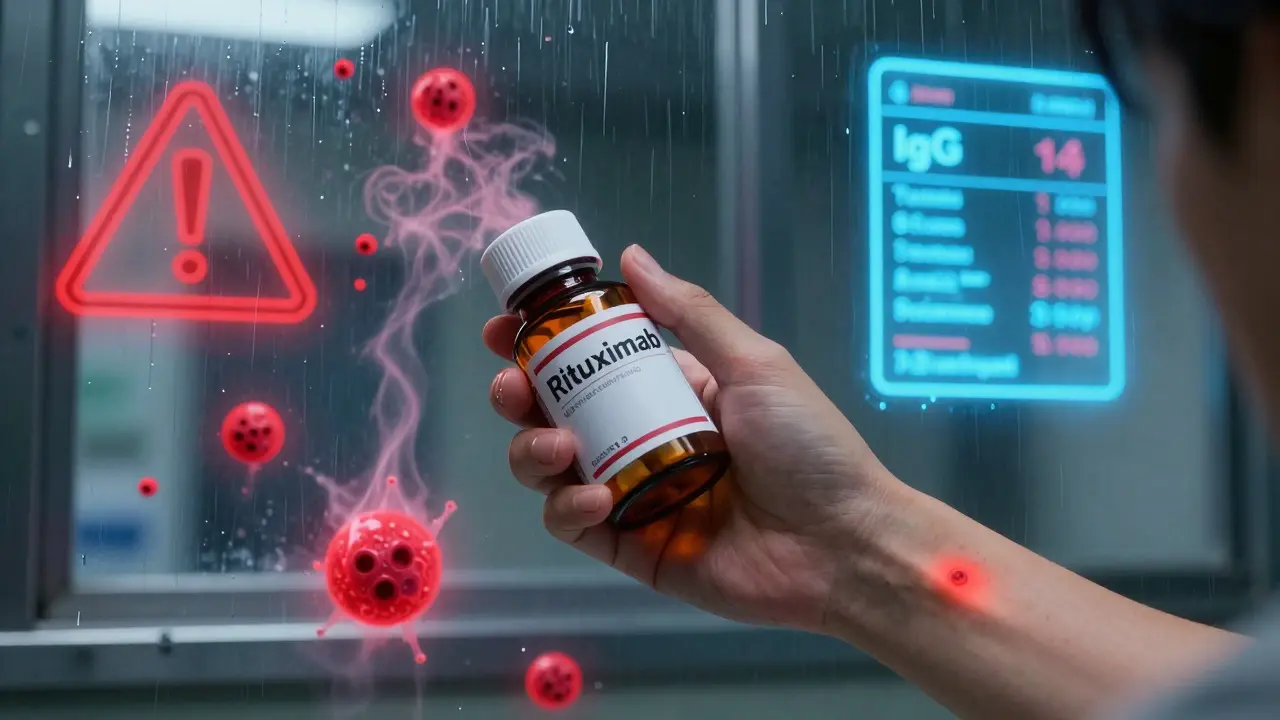
Then there are biologics - drugs like adalimumab (Humira) and rituximab (Rituxan). These are targeted. They block specific immune signals. Rituximab wipes out B-cells, which are critical for fighting viruses and making antibodies. That’s why patients on rituximab can remain at high infection risk for up to six months after their last dose. One patient in Melbourne reported getting shingles four months after her infusion. Her doctor didn’t warn her about that window.
JAK inhibitors like tofacitinib (Xeljanz) are newer. They work inside cells to block inflammation signals. But they come with a hidden danger: blood clots. The FDA added a black box warning after studies showed higher rates of pulmonary embolism and stroke, especially in people over 50 with heart disease. They also reactivate the chickenpox virus more often than other drugs - about 3 to 5 cases per 100 people each year.
Drugs like azathioprine and mycophenolate suppress bone marrow. That means lower white blood cell counts. If you’re on these, you need a blood test every month. Missing one can mean catching an infection before you even feel sick.
The Real Cost of Safety: Infections and Cancer
The biggest fear for most patients isn’t just a cold - it’s hospitalization. About 18% of hospital stays among people on these drugs are due to infections, costing the U.S. healthcare system over $4 billion a year. Pneumonia, sepsis, tuberculosis, and fungal infections are common. And some are deadly.
Cancer risk is another silent issue. JAK inhibitors have been linked to a 44% higher risk of lymphoma and a 34% higher risk of lung cancer in older adults who smoke. That’s why the European Medicines Agency issued a safety alert in early 2023. It’s not common, but it’s real. For someone on long-term therapy, that small percentage adds up.
Even common viruses can turn dangerous. Hepatitis B, which many people carry silently, can flare up violently after starting rituximab. That’s why screening for hepatitis B before starting treatment is now standard - and why some patients get antiviral drugs as a precaution.
What’s the Safest Option?
If you have mild disease, hydroxychloroquine (Plaquenil) might be your best bet. It’s used for lupus and some forms of arthritis. Studies show it doesn’t significantly raise infection risk. It’s also one of the few drugs with a high patient satisfaction rating - 7.8 out of 10 on Drugs.com.
Methotrexate, even at low doses (25 mg a week), is safer than most biologics. It still carries some risk, but only 1.2 times higher than the general population. That’s why many doctors start here before jumping to more powerful drugs.
But if your disease is aggressive - if your joints are being destroyed or your kidneys are failing - then the risks of not treating outweigh the risks of treatment. That’s the balancing act. You’re not choosing between safe and dangerous. You’re choosing between different levels of risk.

Monitoring Is Everything
Most complications aren’t caused by the drugs themselves. They’re caused by not watching for them.
Patients on rituximab need their antibody levels checked every three months. If your IgG levels drop too low, you might need monthly infusions of immune globulin. People on JAK inhibitors should get tested for chickenpox antibodies annually. If you’ve never had chickenpox or the vaccine, you need it before starting - and you need proof of immunity.
Corticosteroid users on high doses need TB skin tests twice a year. If you’re from a country where TB is common, or you’ve worked in healthcare, that’s non-negotiable. And if you’re on any of these drugs, you should never get live vaccines - like the shingles vaccine (Zostavax) or the nasal flu spray. Inactivated vaccines - like the flu shot or pneumococcal shot - are safe, but timing matters. Get them at least four weeks before starting a B-cell depleting drug.
There’s a tool used in 85% of U.S. rheumatology clinics that classifies patients as low, moderate, or high risk based on their exact drug combination. High-risk patients get monthly check-ins with infectious disease specialists. That’s not overkill - it’s prevention.
What Patients Are Saying
Online forums are full of stories. One woman on Reddit wrote: “I got shingles after my second rituximab infusion. The pain lasted four months. My rheumatologist said, ‘It’s rare.’ But it happened to me.”
Another, on PatientsLikeMe, said: “I was on methotrexate for two years. My liver enzymes went through the roof. Switched to sulfasalazine. Less effective for joints, but my liver is fine.”
A nurse with rheumatoid arthritis posted on HealthUnlocked: “I’ve seen colleagues get shingles twice on JAK inhibitors, even after vaccination. Now I test my VZV titers every six months.”
These aren’t outliers. They’re common enough that patient surveys show 42% of people on biologics quit because they were scared of getting sick. And 28% have been hospitalized for an infection while on treatment.
The Future: Smarter, Not Just Stronger
The field is changing. New drugs in development aren’t trying to crush the immune system anymore. They’re aiming to fix the broken signals - like a surgeon instead of a sledgehammer.
The NIH is spending $28 million to find biomarkers that predict who’s most at risk. Early results show that looking at specific T-cell types might tell doctors whether someone needs monthly blood tests or just yearly ones.
Mayo Clinic tested an AI tool that analyzed electronic records and cut serious infections by 22% in a pilot group. It flagged patients who missed blood tests, who hadn’t been vaccinated, or whose drug doses were too high.
Insurance companies are catching on too. Since January 2023, Medicare requires doctors to prove they’ve checked for infections, vaccinated patients, and assessed risk before approving biologics or JAK inhibitors. That’s cut inappropriate use by 37%.
But the biggest challenge is aging. By 2030, over a million Americans over 65 will be on biologics. Their immune systems are weaker. Their bodies heal slower. The current model - blanket suppression - won’t work for them.

What You Need to Do Now
- Know your drug. Not all immunosuppressants are equal. Ask your doctor which class you’re on and what the specific risks are.
- Get vaccinated - early. Don’t wait until you’re on the drug. Get all recommended shots - flu, pneumonia, shingles (the inactivated version), hepatitis B - at least four weeks before starting.
- Get blood tests. Monthly for bone marrow suppressants. Every three months for biologics. Don’t skip them.
- Report fevers or unusual symptoms immediately. A low-grade fever could be the first sign of something serious. Don’t wait.
- Ask about alternatives. Is there a safer option for your level of disease? Methotrexate? Hydroxychloroquine? Sometimes less is more.
When to Call Your Doctor
Call immediately if you have:
- A fever over 38°C (100.4°F) that lasts more than 24 hours
- Unexplained fatigue, night sweats, or weight loss
- Red, swollen, or painful skin that’s spreading
- Cough, shortness of breath, or chest pain
- Blurred vision, confusion, or weakness on one side of your body
These aren’t just symptoms. They could be signs of infection, cancer, or a neurological problem caused by your medication. Waiting even a day can make a difference.
Can I still get vaccines while on immunosuppressants?
Yes - but only inactivated vaccines. That includes the flu shot, pneumococcal vaccine, hepatitis B, and the newer shingles vaccine (Shingrix). Live vaccines like the old shingles shot (Zostavax), MMR, and nasal flu spray are dangerous and should be avoided. Always get vaccines at least four weeks before starting a drug like rituximab or cyclosporine. After starting, some drugs make vaccines less effective, so timing matters more than you think.
Are natural remedies or supplements safe to use with these drugs?
Many aren’t. Turmeric, echinacea, and high-dose vitamin C can interfere with how these drugs work. Some, like St. John’s Wort, can make biologics less effective. Others, like fish oil or vitamin D, may be fine - but you need to check. Don’t assume ‘natural’ means safe. Always tell your rheumatologist what supplements you’re taking. What seems harmless could raise your infection risk or mess with your liver.
How long does immunosuppression last after stopping a drug?
It depends. Corticosteroids wear off in a few weeks. Methotrexate takes about 6 to 8 weeks. But drugs like rituximab can leave your immune system weak for up to 12 months. That’s because they wipe out B-cells, and it takes that long for your body to rebuild them. Even if you feel fine, you’re still at risk. Your doctor should monitor your antibody levels before you stop and after.
Why do some people get infections and others don’t?
It’s not random. Age, smoking, diabetes, kidney disease, and previous infections all raise your risk. So does the combination of drugs - taking prednisone with a biologic is riskier than either alone. Genetics also play a role. Some people’s immune systems recover faster. That’s why personalized monitoring is becoming standard. It’s not one-size-fits-all anymore.
Is there a way to test how suppressed my immune system is?
Yes. Blood tests can measure your white blood cell count, IgG antibody levels, and specific immune cell subsets. For people on rituximab or other B-cell drugs, checking CD19+ B-cell counts tells your doctor how long you’re at risk. Some clinics now use advanced tests that look at T-cell function. These aren’t routine everywhere yet, but if you’ve had multiple infections, ask your doctor if they’re available.
What happens if I miss a blood test or skip a doctor’s appointment?
You’re flying blind. Many complications - like low white blood cells, rising liver enzymes, or early signs of cancer - have no symptoms at first. Missing a test means you could develop a serious infection or organ damage without knowing. Insurance companies now require proof of monitoring before approving refills. But more importantly, your life depends on it. Don’t skip appointments. If you can’t make it, reschedule immediately. There’s no such thing as a ‘routine’ check-up when you’re on these drugs.
Final Thought: Control, Not Control
These drugs give you back your life - but they don’t give you back your immunity. The goal isn’t to eliminate all risk. It’s to manage it. Know your drug. Track your health. Speak up. The best treatment isn’t the strongest one - it’s the one you understand, monitor, and live with safely.
Marc Durocher
February 4, 2026 AT 07:39larry keenan
February 5, 2026 AT 11:06Gary Mitts
February 7, 2026 AT 06:09clarissa sulio
February 7, 2026 AT 23:39Anthony Massirman
February 8, 2026 AT 18:17Bridget Molokomme
February 9, 2026 AT 16:05Monica Slypig
February 10, 2026 AT 22:06Becky M.
February 11, 2026 AT 07:45jay patel
February 11, 2026 AT 09:40Ansley Mayson
February 13, 2026 AT 01:22phara don
February 13, 2026 AT 10:19