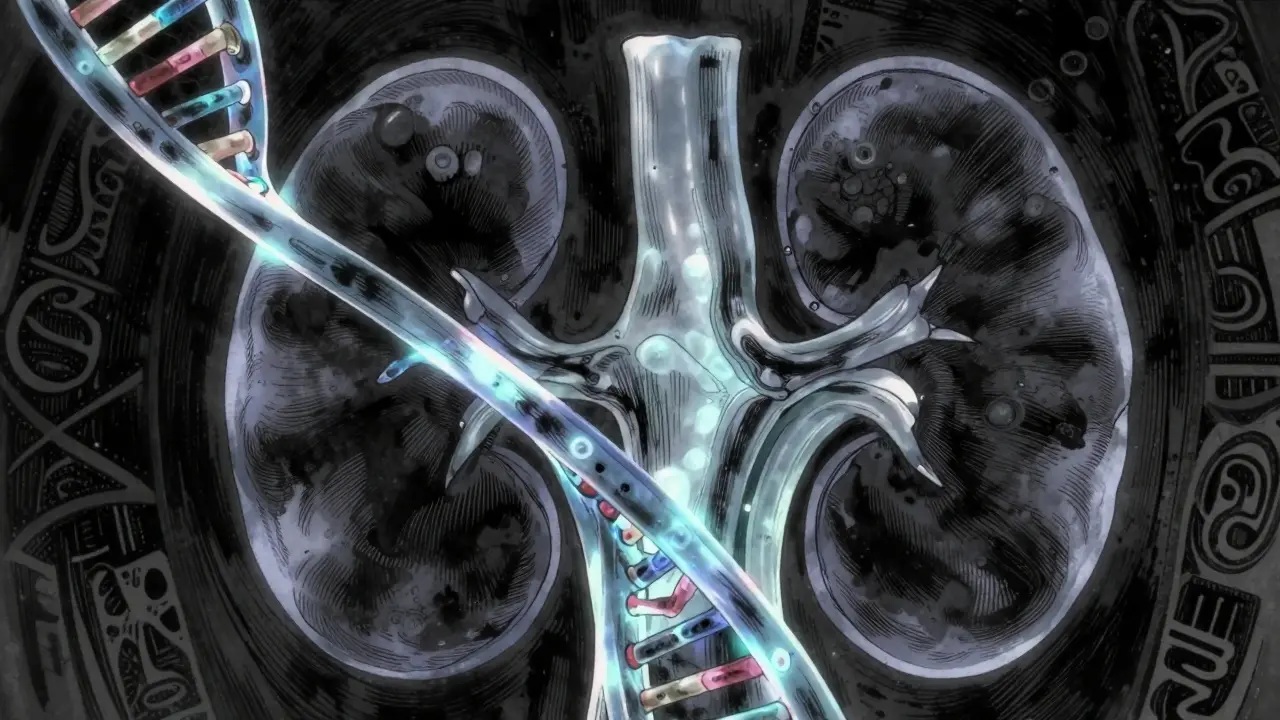
For decades, doctors noticed something troubling that statistics couldn't easily explain. People with African ancestry faced significantly higher rates of kidney failure compared to other groups. It wasn't just diet or blood pressure alone. In 2015, scientists finally pinpointed a major culprit hidden in our DNA: the APOL1 Gene. This discovery changed how we view kidney health disparities globally. Today, understanding this genetic risk is no longer optional; it is essential for protecting long-term renal health.
What Is the APOL1 Gene?
Apolipoprotein L1 (APOL1) is a protein-coding gene located on chromosome 22 that plays a critical role in the body's immune defense. Specifically, it helps fight off parasites. For thousands of years, certain versions of this gene protected ancestors living in sub-Saharan Africa from sleeping sickness, caused by a parasite called Trypanosoma brucei rhodesiense. However, evolution comes with trade-offs. The very mutations that offered protection against infection increased the risk of damaging the kidneys over a lifetime.
This creates a unique medical situation. While most genetic disorders affect anyone regardless of background, APOL1-related kidney risk is deeply tied to recent geographic ancestry. Research shows that approximately 70% of the excess kidney disease risk seen in people of African descent can be linked directly to these two gene variants. Without this knowledge, many patients were left wondering why they developed kidney issues despite taking good care of their health.
The Evolutionary Trade-Off
To understand why this matters, you have to look back about 3,000 to 10,000 years ago. During this time, populations in West and Central Africa needed protection against the deadly trypanosome parasite. Natural selection favored individuals carrying specific mutations in the APOL1 gene-specifically the G1 and G2 variants. These mutations allowed the protein to puncture the parasite's membrane, killing it before it could cause sleeping sickness.
These variants spread rapidly through the population because the benefit of surviving an infection outweighed the distant risk of kidney problems later in life. Once humans migrated away from the tsetse fly zone-like during the transatlantic diaspora-the infectious threat vanished, but the genes remained. Now, without the parasite to fight, the protective mechanism simply becomes harmful to the kidney cells. Dr. Martin Pollak from Harvard Medical School has noted that APOL1 represents one of the strongest genetic risk factors ever discovered for a common disease.

Identifying High-Risk Genotypes
Not everyone with African ancestry carries these risk variants, and not everyone who carries them will get sick. The risk follows a specific genetic pattern known as recessive inheritance. You need two copies of the risky gene to be considered "high-risk." If you inherit only one copy from one parent, you generally have normal kidney function.
There are three main ways to be high-risk:
- Homozygous G1: Two copies of the G1 variant.
- Homozygous G2: Two copies of the G2 variant.
- Compound Heterozygous: One copy of G1 and one copy of G2.
| Population Group | High-Risk Prevalence | Context |
|---|---|---|
| African Americans (USA) | ~13% | General Population |
| African Americans with Non-Diabetic Kidney Disease | ~50% | Already diagnosed with kidney issues |
| West Africans (e.g., Ghana, Nigeria) | ~30% | Current regional prevalence |
| European/Asian/Indigenous American | Extremely Rare | Virtually absent in these populations |
About 13% of self-identified African Americans carry these high-risk genotypes. That number jumps dramatically to roughly 50% among those already suffering from non-diabetic kidney disease. This stark difference highlights why genetic testing is becoming a crucial tool for diagnosis. Interestingly, these variants are virtually non-existent in European, Asian, and Indigenous American populations, explaining the geographic disparity in health outcomes.
Kidney Diseases Linked to APOL1
Having the high-risk genotype doesn't guarantee kidney failure. In fact, about 70% of people with these genes maintain normal kidney function throughout their lives. This phenomenon is called incomplete penetrance. To trigger disease, a "second hit" usually occurs. This could be high blood pressure, a viral infection like HIV, diabetes, or other environmental stressors.
When disease does develop, it often presents as aggressive forms of kidney damage. Common conditions associated with APOL1 include:
- Focal Segmental Glomerulosclerosis (FSGS): A scarring condition in the kidney's filtering units.
- Arterionephrosclerosis: Hardening of the small arteries inside the kidney.
- Collapsing Glomerulopathies: Including HIV-associated nephropathy (HIVAN).
Research indicates that nearly half of all end-stage kidney disease (ESKD) cases in people with HIV and African ancestry are attributable to APOL1. Even outside of HIV, the gene explains a large portion of the racial disparity in kidney failure rates. Recognizing these specific diagnoses early allows doctors to tailor treatment more effectively.

Testing and Diagnosis
Genetic testing for APOL1 became clinically available around 2016. It isn't just academic anymore; labs like Invitae and PreventionGenetics offer these tests routinely. The cost typically ranges from $250 to $450 if paying out-of-pocket, though insurance coverage varies. Getting tested is particularly recommended for living kidney donors with African ancestry. Why? Because donating a kidney raises your blood pressure slightly, which might push someone with a high-risk genotype toward kidney disease sooner than expected.
Despite availability, adoption has been slow. A survey found that nearly 80% of nephrologists felt inadequately trained to counsel patients about these results. There is also confusion about what the results mean. Many people think a positive test means they will definitely get sick. In reality, it means they are at higher risk, much like having a family history of heart disease.
Clinicians now recommend annual monitoring for anyone with a high-risk result. This includes checking the urine albumin-to-creatinine ratio and keeping blood pressure strictly below 130/80 mmHg. Early intervention stories show promise; for example, patients who started aggressive blood pressure management after learning their status have preserved kidney function for years.
Treatment and Future Therapies
Until recently, managing APOL1 risk meant treating the symptoms rather than the root cause. Doctors controlled blood pressure and reduced protein in the urine using standard medications like ACE inhibitors or ARBs. However, we are entering a new era of precision medicine.
Pharmaceutical companies have recognized the potential here. Vertex Pharmaceuticals committed $1.5 billion to developing APOL1 inhibitors through 2025. These drugs aim to suppress the toxic activity of the mutant protein in the kidney without compromising the immune system elsewhere. As of late 2023, early trials showed promising results in reducing proteinuria (protein in urine), a key marker of kidney damage.
The National Institutes of Health launched a massive 10-year observational study in September 2023 to track 5,000 individuals with high-risk genotypes. This project aims to refine prediction tools and screening guidelines. By targeting the genetic pathway directly, experts hope to close the gap in kidney health outcomes between racial groups. However, equitable access remains a hurdle; currently, only 12% of low- and middle-income countries have access to this testing.
Do I need APOL1 testing if I have kidney issues?
If you have African ancestry and have been diagnosed with unexplained kidney disease, specifically FSGS or high blood pressure with kidney damage, testing is highly recommended. It helps determine the underlying cause and may qualify you for specific clinical trials.
Can diet changes help with APOL1 risk?
While diet cannot change your genetics, a healthy lifestyle reduces the 'second hit' stress on your kidneys. Reducing sodium intake and maintaining a healthy weight lowers blood pressure, which is critical for delaying or preventing disease onset in high-risk individuals.
Is APOL1 risk determined by race?
No, it is determined by genetic ancestry. While it correlates with Black identity in the US due to shared history, the risk factor applies to anyone with recent ancestors from regions in sub-Saharan Africa where the mutation was selected.
Will having the APOL1 gene prevent me from donating a kidney?
Not necessarily. High-risk genotypes increase the chance of future kidney failure in donors. Transplant centers evaluate this carefully using guidelines from the APOLLO network to ensure donor safety while offering life-saving options to recipients.
Are there any treatments specifically for APOL1 yet?
As of early 2026, several therapies are in advanced clinical trials. Drugs like VX-147 aim to target the gene's pathway. Current management focuses heavily on rigorous blood pressure control and avoiding nephrotoxic substances.
Calvin H
March 30, 2026 AT 06:47Another expensive way to tell people why they feel tired.
RONALD FOWLER
March 31, 2026 AT 04:16I hear your concerns and i understand the struggle completely
we should move forward together with grace
Ruth Wambui
April 1, 2026 AT 06:07The big pharma types are probably cooking the books on these stats again to hide their own failures in the system
Michael Kinkoph
April 3, 2026 AT 02:35While, it is; true, that genetics; play a part, we must also consider, the environment; and one should read the papers properly before assuming control
Brian Yap
April 4, 2026 AT 15:29G'day mate, reckon this info could save lives down under too
great find
Dan Stoof
April 6, 2026 AT 00:49Bright futures await those who peek behind the curtain of science!
You have so much power today!
Cameron Redic
April 7, 2026 AT 23:50Stop crying about genes and fix your diet before blaming dna for everything wrong in your life
most people are just lazy
Carolyn Kask
April 8, 2026 AT 11:47This affects us less so we shouldn't waste national resources on global problems instead of fixing our own borders first
William Rhodes
April 9, 2026 AT 22:45We can beat this!
Stand tall against the odds!
Our bodies are warriors ready to adapt and win the battle for health every single day
Marwood Construction
April 11, 2026 AT 01:58The structural integrity of renal function is compromised significantly
Further observation is required
Biraju Shah
April 12, 2026 AT 03:11You need to listen and act now for your family safety
Do not wait until the damage is done
Katie Riston
April 13, 2026 AT 20:33Evolution is a strange river that flows backwards sometimes.
You see the protection come first.
Then you see the cost appear later.
It is really difficult to plan for the future generations.
Science tells us about the mechanics.
But the soul feels the weight differently.
People carry history in their cells now.
We ignore that connection often.
The tests are available for everyone.
Yet few choose to take the step forward.
Fear holds us back more than the disease does.
Knowledge is supposed to free us from the dark.
Sometimes knowledge brings new kinds of worry.
We must balance the fear with action.
Living fully is the only victory we truly have.